Why Bangkok’s Yellow Flags Mean More Than “Vegan Week” (เจ Explained)
What those yellow flags really mean, why เจ is different from ordinary vegetarian food, and how to use a little Thai to understand one of Bangkok’s most interesting annual traditions.
By Arthit Juyaso (Bingo)
Principal and Curriculum Developer, Duke Language School
Author of Read Thai in 10 Days
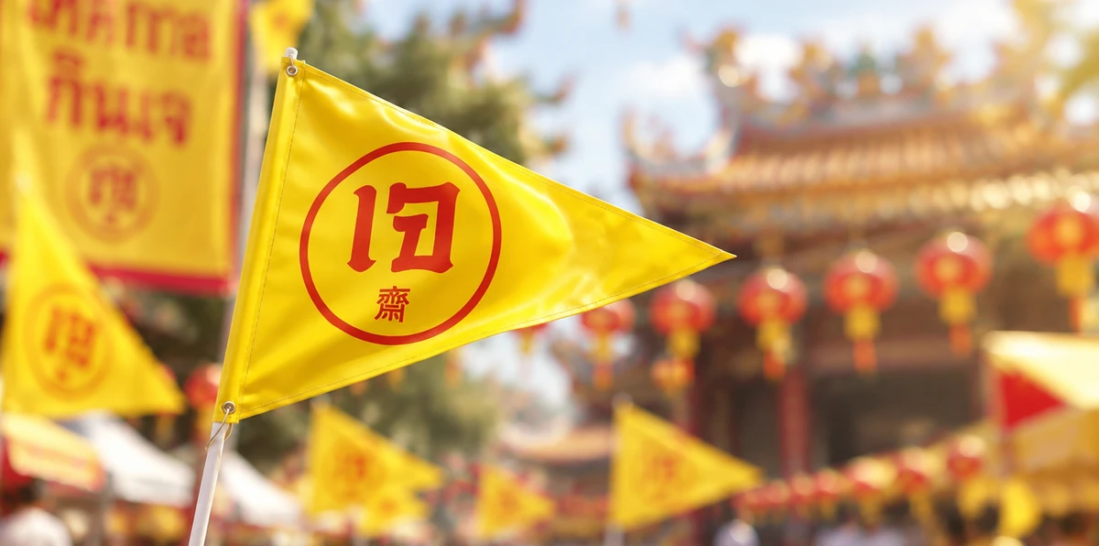
If you spend enough time in Bangkok, you’ll notice something unusual happening around October. Yellow flags begin appearing outside restaurants, food carts, supermarkets, and the little rice-and-curry shops you pass every day. Most have the Thai word เจ (jee) printed prominently in red. Suddenly, places that normally sell pork, chicken, and seafood are offering completely different menus.
Ask someone what’s happening and they’ll probably tell you it’s the vegetarian festival, or perhaps simply “vegan week.” Neither explanation is entirely wrong, but both leave out something important.
Those yellow flags identify เจ (jee) food, a form of plant-based cooking associated with a Chinese-Thai tradition of religious observance, self-discipline, and purification. The food excludes animal products and certain pungent vegetables, particularly garlic and onions. During the annual festival, usually observed for nine days according to the Chinese lunar calendar, many people choose to follow these dietary rules as part of a wider spiritual or cultural practice.
In Thai, this is called กินเจ (ginjee), commonly written kin je or kin jay in English. Once you understand what it means, you start to notice that the festival isn’t simply about what people stop eating. It’s also about why they do it, how they observe it, and the small ways it brings people together.
What Do the Yellow Flags Mean in Bangkok?
A yellow flag displaying เจ tells customers that a restaurant or stall is offering food prepared according to the rules of เจ. The most obvious requirement is that the food contains no meat, fish, or other animal products, but there are additional restrictions that distinguish it from ordinary vegan cooking.
The flags are particularly noticeable during Thailand’s annual Vegetarian Festival, known in Thai as เทศกาลกินเจ (têetsagaan ginjee). The festival takes place during the ninth month of the Chinese lunar calendar, meaning its dates change each year. It usually falls in September or October and is observed for nine days, although preparations and celebrations may extend beyond that period.
One detail worth knowing is that yellow เจ flags aren’t exclusive to the festival. Some restaurants serve เจ food throughout the year, especially in areas with established Chinese-Thai communities. What changes during the festival is the scale. Supermarkets introduce dedicated sections, street vendors adjust their menus, and restaurants that normally serve meat may begin offering เจ dishes.
For 2026, the main vegetarian observance runs from 10 to 18 October, while festival activities in Bangkok’s Yaowarat district begin on 9 October. If you’re reading this in another year, check the current dates, since the lunar calendar doesn’t line up with the same dates every October.
There’s also a useful distinction between what a flag tells you and what it guarantees. The flag signals that the vendor is offering เจ food, but it isn’t an independent food-safety certification. People with serious allergies or strict requirements should still ask about ingredients and preparation.
Is เจ the Same as Vegan or Vegetarian Food?
Not quite. There is considerable overlap, but the terms describe different things.
In everyday English, vegetarian generally refers to food that contains no meat or fish, although eggs and dairy may be included. Vegan food excludes animal-derived ingredients entirely. Garlic, onions, and other pungent vegetables are normally acceptable in both.
เจ food excludes animal products, including eggs and dairy, but traditionally also avoids several pungent vegetables. These commonly include garlic, onions, shallots, chives, and related plants. That’s one of the most practical differences for anyone trying to understand the festival.
Imagine ordering a plate of stir-fried mushrooms at an ordinary restaurant. If it’s prepared without meat, fish sauce, oyster sauce, or other animal products, it might be perfectly vegan. But if the cook uses garlic oil or adds chopped shallots, it wouldn’t meet the traditional requirements of เจ.
Now consider a vegetable dish at a stall displaying the yellow flag. The vendor should already be preparing it according to the เจ rules, including avoiding the restricted ingredients. That’s why using the word เจ is often more useful than asking for something vaguely “vegetarian.”
What About มังสวิรัติ?
You’ll also encounter another Thai word, มังสวิรัติ (mangsawírát), meaning vegetarian. It’s a general dietary term used throughout the year, not something specifically tied to the Chinese-Thai festival.
The distinction matters when ordering food. Someone asking for มังสวิรัติ might be comfortable eating eggs or dairy, while someone asking for เจ generally expects those ingredients to be excluded, along with the prohibited pungent vegetables. The exact practices associated with vegetarianism can vary, so it’s worth checking if particular ingredients matter to you.
These aren’t simply three names for the same diet. Vegetarian and vegan describe dietary choices, although veganism can also extend to other aspects of life. เจ describes a particular way of preparing food and, during the festival, a cultural and often religious practice.
One more thing is worth mentioning. Plant-based doesn’t automatically mean healthy. Some festival dishes are deep-fried or made with heavily processed meat substitutes, while others contain generous amounts of oil, salt, or refined carbohydrates. You can find plenty of excellent vegetable dishes, tofu, and other nutritious options, but the yellow flag isn’t a nutritional rating.
Why Do People Eat เจ for Nine Days?
The annual Vegetarian Festival has deep roots in Chinese-Thai communities and traditions associated with the Nine Emperor Gods. Religious observance is an important part of the festival, especially in communities where Chinese shrines continue to play a central role.
For many participants, abstaining from animal products is part of a broader effort to practise compassion, self-discipline, and purity of body and mind. Depending on their beliefs and traditions, people may also refrain from alcohol, wear white clothing, visit shrines, make merit, or observe other religious customs.
That’s the part of the festival that the expression “vegan week” doesn’t really capture. The food is visible everywhere, but for many people it’s part of something much more personal.
Of course, not everyone participates for exactly the same reason. Some observe the full nine days as a religious commitment. Others join because it’s a family tradition, because they want to support someone close to them, or because they enjoy the food and the atmosphere. Some may observe only part of the festival.
These differences don’t make the tradition meaningless. They reflect how a long-established cultural practice fits into modern Bangkok life.
กินเจ and ถือเจ: Two Thai Expressions Worth Knowing
Thai has two common ways of talking about participation in the festival.
กินเจ (ginjee) literally means “to eat เจ.” It’s the straightforward expression you’ll hear when someone talks about eating the festival’s food.
ถือเจ (tʉ̌ʉjee) is closer to “observing เจ” or “keeping the practice.” The verb ถือ (tʉ̌ʉ) means to hold or maintain something, and in this context suggests a commitment rather than simply choosing a particular meal.
The difference isn’t absolute. Thai speakers may use the expressions interchangeably in everyday conversation. Still, understanding the nuance helps explain why a question about eating เจ can sometimes carry a little more meaning than a simple question about lunch.
For someone observing the festival seriously, the decision may reflect a personal belief or family custom. You don’t need to share that belief to understand why the practice matters to them.
How to Talk About เจ in Everyday Thai
One of the nice things about the festival is that you don’t need much Thai to participate in the conversations happening around you. A few useful words are enough, whether you’re ordering food, joining colleagues for lunch, or asking someone about the yellow flags outside a shop.
Here are some expressions worth knowing.
| Thai | DLS Pronunciation | Meaning |
|---|---|---|
| มีเจมั้ย | miijee mái | Do you have เจ food? |
| อันนี้เจมั้ย | anníi jee mái | Is this เจ? |
| ขอเจหน่อย | kɔ̌ɔ jee nɔ̀i | เจ food, please. |
| ถือเจมั้ย | tʉ̌ʉjee mái | Are you observing เจ? |
| กินเจอยู่ | ginjee yùu | I’m eating เจ / observing the festival. |
| ปีนี้ไม่ได้กินเจ | bpiiníi mâi dâai ginjee | I’m not observing it this year. |
At a Food Stall
Suppose you’re standing in front of a stall selling several dishes. You notice the yellow flag, but you’re not sure whether everything on display is prepared according to เจ rules.
Rather than trying to explain your dietary requirements in English, you can point to a dish and ask อันนี้เจมั้ย (anníi jee mái), meaning “Is this เจ?”
It’s a small question, but a useful one. You’re using a word the vendor understands in the context of their own cooking, and you’re asking about the particular dish you want. If the vendor confirms it is เจ, you can order without having to explain the entire dietary tradition.
If something matters especially to you, be specific. For example, ไม่ใส่กระเทียม (mâi sài gràtiiam) means “no garlic.” Don’t assume that asking for a vegetarian dish at an ordinary restaurant automatically covers every ingredient you need to avoid.
For serious food allergies, explaining your specific restriction and checking the preparation method is still important, regardless of the flag.
At the Office
The festival also provides a good example of how food and social interaction overlap in Thai culture.
Imagine someone at work asking ถือเจมั้ย (tʉ̌ʉjee mái), meaning “Are you observing เจ?” They may simply be curious, or they might be organising a group lunch and trying to find somewhere everyone can eat.
If you’re participating, กินเจอยู่ (ginjee yùu) is a perfectly natural answer. If you’re not, you can say ปีนี้ไม่ได้กินเจ (bpiiníi mâi dâai ginjee), meaning “I’m not observing it this year.”
You don’t need a long explanation either way. In most situations, a friendly answer is enough. If you’re interested in how Thai speakers handle polite refusals, we’ve also explored how to say no in Thai without creating unnecessary awkwardness.
It’s also worth being considerate when sharing meals. If several colleagues are observing เจ and someone is organising food for the table, checking what everyone can eat is more useful than making assumptions. You don’t have to participate yourself, but understanding the practice makes it easier to accommodate people who do.
This is where learning Thai becomes more interesting than memorising vocabulary. You’re not merely translating a sentence. You’re recognising what someone is asking, why they’re asking it, and how to respond appropriately.
Where Can You Experience the Vegetarian Festival in Bangkok?
For most visitors, Bangkok’s Chinatown is the obvious place to start.
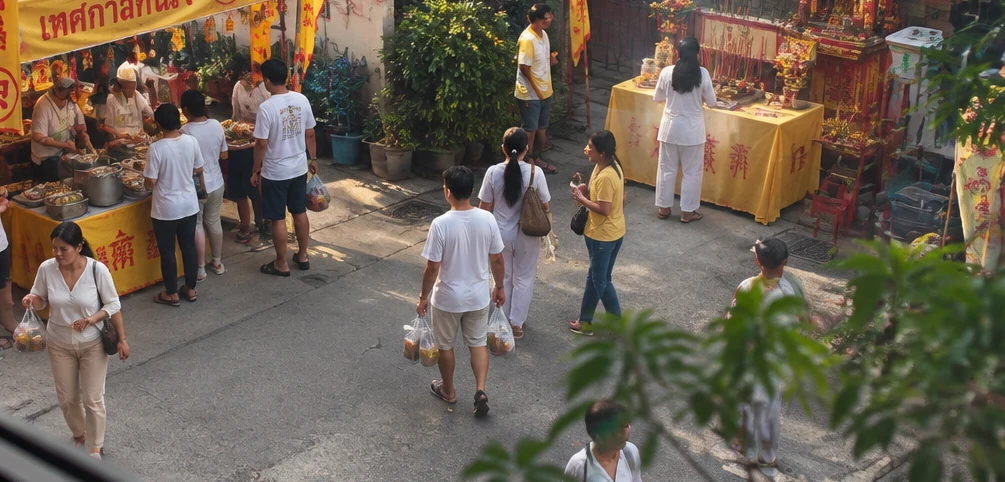
During the festival, Yaowarat becomes one of the city’s busiest areas for เจ food. Yellow flags hang above stalls, restaurants introduce festival menus, and the streets fill with people looking for everything from traditional Chinese-Thai dishes to creative plant-based versions of familiar meals.
You’ll find tofu, mushrooms, noodles, vegetable curries, and mock meats made from ingredients such as soy and wheat gluten. Some dishes look surprisingly similar to the meat versions they’re replacing. Others are traditional dishes that happen to be particularly well suited to เจ cooking.
There’s more to the festival than street food, though. Chinese shrines, religious ceremonies, and community celebrations are also part of the experience. These are important reminders that the festival’s meaning extends beyond what appears on restaurant menus.
Is Bangkok’s Festival the Same as Phuket’s?
Both are connected to Chinese-Thai religious traditions, but the celebrations have developed different local characteristics.
Phuket’s Vegetarian Festival is especially famous for its elaborate shrine ceremonies, processions, and striking acts of religious devotion. These practices attract visitors from around the world, although for those taking part they are acts of faith rather than performances staged for tourists.
Bangkok has religious activities and processions too, particularly around Chinatown, but many visitors experience the festival primarily through its food stalls, decorations, and busy streets. The atmosphere can be quite different from Phuket’s, so it’s worth understanding each celebration on its own terms.
Sometimes the Best Place to Experience เจ Is Your Own Soi
Yaowarat is an obvious destination, but you don’t need to visit Chinatown to notice the festival.
One of the most interesting things about Bangkok during this period is how ordinary neighbourhoods change. A restaurant that usually serves meat dishes might introduce a separate เจ menu. The rice-and-curry stall near your office might put up a small yellow flag, while your local supermarket suddenly has an entire section devoted to festival food.
These small changes are easy to overlook when you don’t understand what they mean. Once you can recognise เจ, though, they’re all connected to the same tradition.
Bangkok has a habit of revealing itself through everyday details. We explored something similar in our article about why Bangkok was once called the Venice of the East. Whether you’re noticing the city’s canals, its rainy-season habits, or a yellow flag outside your favourite food stall, a little cultural knowledge can change how you see a familiar place.
That’s something I find especially rewarding about learning Thai in Bangkok. A word you might encounter in class can suddenly explain something you’ve been walking past for years. The street hasn’t changed very much, but your understanding of it has.
Frequently Asked Questions About Bangkok’s Yellow Flags and เจ
Quick FAQ Navigation
What Do the Yellow Flags with Red Writing Mean in Thailand?
Yellow flags marked with เจ identify food prepared according to the Thai-Chinese เจ tradition. The food should contain no animal-derived ingredients or certain pungent vegetables, including garlic and onions. These flags become particularly widespread during Thailand’s annual Vegetarian Festival, although some restaurants display them throughout the year.
Is เจ Food Vegan?
Properly prepared เจ food meets the usual dietary requirements of vegan food because it excludes meat, seafood, eggs, dairy, and other animal-derived ingredients. However, เจ also excludes certain pungent vegetables that are normally acceptable in vegan cooking. Veganism can also describe a broader lifestyle, while เจ is associated with particular dietary and cultural traditions.
What Is the Difference Between กินเจ and ถือเจ?
กินเจ (ginjee) means eating เจ food. ถือเจ (tʉ̌ʉjee) means observing or keeping the เจ practice. In everyday conversation, Thai speakers may use both expressions to describe someone participating in the festival, although ถือเจ places slightly more emphasis on observance.
Why Can’t You Eat Garlic or Onions During the Vegetarian Festival?
Traditional เจ rules exclude several pungent vegetables, including garlic, onions, shallots, and chives. The restriction is associated with traditional beliefs about bodily and mental purity during religious observance. The exact prohibited-plant lists and levels of observance can vary across traditions, but avoiding garlic and onions is one of the most recognisable characteristics of เจ food.
When Is the Vegetarian Festival in Bangkok in 2026?
The main nine-day observance takes place from 10 to 18 October 2026. Yaowarat festival activities are scheduled from 9 to 18 October. The festival follows the Chinese lunar calendar, so the dates change from year to year.
Can You Eat เจ Food Outside the Vegetarian Festival?
Yes. Some restaurants and food stalls serve เจ food throughout the year, particularly in areas with established Chinese-Thai communities. The annual festival makes it much easier to find because many additional businesses introduce เจ menus for the occasion. You don’t need to be observing the festival to order and enjoy the food.
Do I Have to Be Religious to Participate in กินเจ?
No. Although กินเจ has strong religious and cultural roots, people participate for different reasons. Some observe it as a spiritual commitment, while others take part because of family traditions, personal preferences, or an interest in the food. Visitors can also enjoy เจ dishes without observing the festival’s religious practices.
The Next Time You See a Yellow Flag
Bangkok is full of things that make more sense once you understand a little Thai. A sign on a shop, a phrase you hear at lunch, or a flag outside a familiar food stall can tell you something about the people and traditions around you.
The yellow เจ flag is a particularly good example. At first, it might seem like nothing more than a convenient way to find vegan food. But behind that one Thai word is a tradition involving faith, family, self-discipline, and community, with a history that extends well beyond the nine days when the flags are most visible.
At Duke Language School, we believe learning Thai should help you understand the place where you live, not just teach you how to order food or ask for directions. Of course, learning how to order food is a pretty good place to start.
So the next time you see a yellow flag, take a closer look. Perhaps try a dish you’ve never eaten before, or ask the vendor อันนี้เจมั้ย (anníi jee mái). You might learn something about the food, practise a little Thai, and discover a side of Bangkok that was there all along.
If you’d like to understand more of the language you encounter every day, explore our Thai language courses in Bangkok.
About the Author
Arthit Juyaso (Bingo) is the Principal and Curriculum Developer at Duke Language School. He is also a Thai language educator and the author of Read Thai in 10 Days.
Over the past two decades, he has helped thousands of learners from around the world develop practical, conversational Thai. His teaching approach focuses on clear explanations, real communication and giving learners enough structured practice to turn what they know into language they can actually use.
Sources and Further Reading
- Tourism Authority of Thailand. Thailand Vegetarian Festival 2025 Celebrates Spiritual Purity and Cultural Heritage. Background on the religious and cultural significance of the festival.
- Thai PBS. Vegetarian Festival Traditions and Dietary Requirements. Information about vegetarian festival traditions and food-related considerations.
- Thailand Public Relations Department. Vegetarian Festival in Celebration of His Majesty the King’s 72nd Birthday. Background on the festival’s cultural significance.
- The Nation Thailand. Bangkok’s Yaowarat Vegetarian Festival Runs from October 9–18, 2026. The 2026 programme, including festival dates, food stalls, and religious activities.