By Arthit Juyaso (Bingo)
Principal and Curriculum Developer, Duke Language School
Author of Read Thai in 10 Days
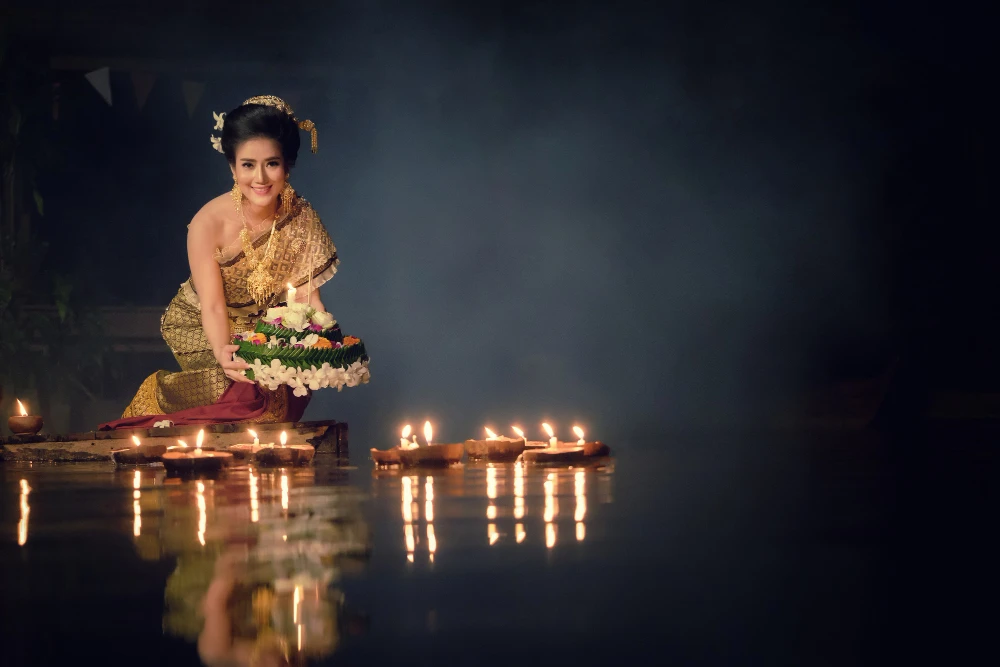
Thai children grow up with this story: a gifted young woman at the Sukhothai court, นางนพมาศ (Nang Noppamas), made a lotus-shaped float of banana leaves, flowers, incense and a candle, and set it on the water for the king. He was so taken with the offering, and in many tellings with her, that floating a krathong became a royal tradition.
That is the best-known origin story of Loy Krathong (also spelled Loi Krathong). But did Nang Noppamas really invent the festival? The story has been told for generations, yet historians have found that the book in which she appears was written centuries after the Sukhothai period.
This article tells that story, then looks at where it comes from, what the historical evidence actually says, and why Nang Noppamas remains such an important part of Thai culture.
What Is Loy Krathong?
Loy Krathong is the night, on the full moon of the 12th Thai lunar month, when people float a small decorated krathong on a river, canal or pond. In 2026, that night falls on Tuesday 24 November. The date moves each year with the lunar calendar.
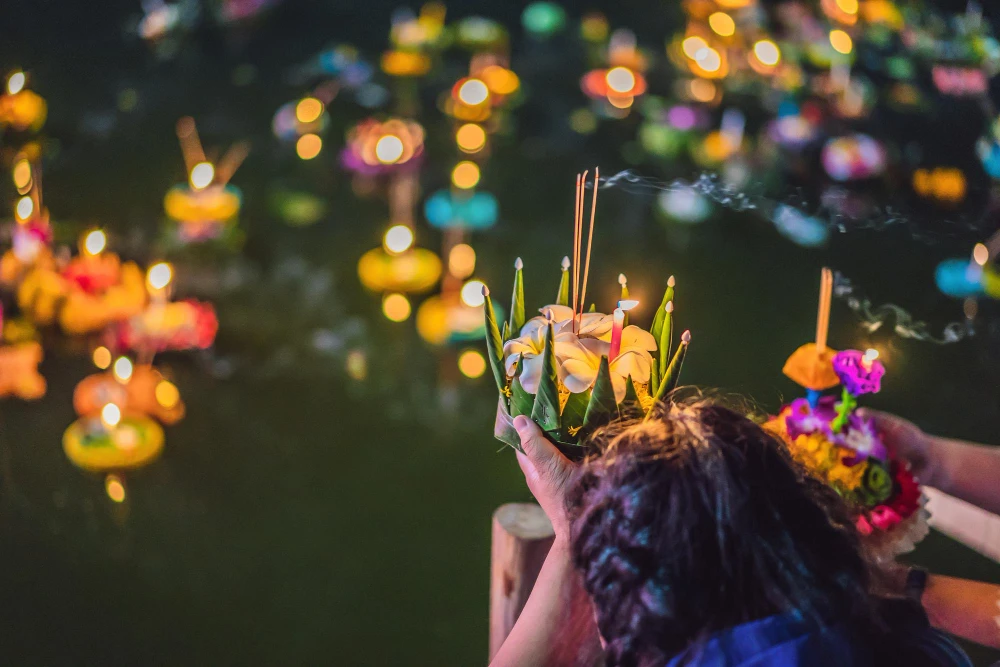
A krathong (กระทง, gratong) is usually made from a base of banana trunk covered with folded banana leaves, flowers, incense and a candle. People light the candle, make a wish, and gently set the krathong on the water. Many also ask forgiveness of พระแม่คงคา (Phra Mae Khongkha), the goddess of water, for the ways people use and sometimes pollute rivers and waterways.
Loy Krathong is not the same as Yi Peng (ยี่เป็ง, yîi bpeng), the northern Lanna festival associated with lantern displays and the release of sky lanterns (โคมลอย, koomlɔɔi). The two celebrations often take place around the same time, particularly in Chiang Mai, but they have different cultural histories and traditions.
For more about the festival’s meaning and how to make your own krathong, see our guide to Loy Krathong and making a traditional krathong.
The Story of Nang Noppamas
In the version most Thai people learn, นางนพมาศ (Nang Noppamas, naang nóppamâat, also spelled Nopphamat) is a gifted young woman at the Sukhothai court of สมเด็จพระร่วงเจ้า (Somdet Phra Ruang Chao). She is the daughter of a Brahmin priest, and she is known for her skill and wisdom, not only for her beauty.
On the full moon of the 12th month, at the royal lamp rite called จองเปรียง (jɔɔng bpriang), she makes her lantern in the shape of a blooming night lotus (ดอกกมุท, dɔ̀ɔk gamút). She decorates it with flowers, carved fruit shaped like birds, candles, incense and a lamp.
Her creation is unlike the other lanterns prepared for the ceremony. Rather than simply making something beautiful, she uses the lotus shape to give the offering religious meaning.
When she sets it on the water, the king admires it and asks what it represents. He is so impressed by her explanation and craftsmanship that he orders future kings to float lotus-shaped lanterns on the same full moon each year, in honour of the Buddha’s footprint.
That is how, in the popular story, Loy Krathong begins.
The love-story reading is part of how the tale is often told today. The book itself spends more time on her conduct, intelligence, skill and the court’s yearly rites than on romance. Nang Noppamas is presented as an ideal court lady, someone whose abilities and character earn the king’s admiration.
There is something appealing about that version of the story. A young woman creates something beautiful, explains its meaning, and supposedly begins a tradition that people continue centuries later. It is easy to understand why the tale has remained popular.
But the historical question is a different one.
Was Nang Noppamas a Real Person?
There is no known contemporary Sukhothai record of a woman named Nang Noppamas. Thai historians have therefore long treated her as a literary heroine rather than a documented historical person.
That does not prove a woman by that name never existed. It means there is no reliable historical evidence establishing her as the inventor of Loy Krathong.
The story comes from a book called ตำรับท้าวศรีจุฬาลักษณ์ (dtamràp táao sǐi jùlaalák), known in English as Tamrap Thao Sri Chulalak, or simply Nang Noppamas. Although the narrative is set in Sukhothai, historians have dated the work to the early Bangkok, or Rattanakosin, period.
Prince Damrong Rajanubhab discussed its early Bangkok origins in his preface to the 1914 edition. Later Thai historians, including Nidhi Eoseewong and Sujit Wongthes, have also questioned the traditional Sukhothai dating.
Research by historian Trongjai Hutangkura at the Princess Maha Chakri Sirindhorn Anthropology Centre examines the historical clues within the text. These include its language, geographical descriptions and references to foreign peoples and events that belong to periods long after the Sukhothai Kingdom.
Why Do Historians Date the Book to Early Bangkok?
One clue is the language. The writing differs from surviving Sukhothai literature and resembles later Thai literary styles.
Another is geography. The book describes Sukhothai as a city surrounded by rivers, a description more suggestive of Ayutthaya than the actual setting of ancient Sukhothai.
There are also references to foreign peoples and historical circumstances that would have been unfamiliar to someone writing in the Sukhothai period. Trongjai Hutangkura’s analysis suggests that, if the book was composed during the reign of King Rama III, a plausible period is between 1833 and 1851.
Some passages have been attributed to King Rama III, but the authorship of the work is not conclusively established.
One quiet fact makes this easier to discuss with respect. The 1914 edition that helped spread the story already included Prince Damrong’s explanation that it was early Bangkok writing. This is not simply a modern attempt to correct an old Thai tradition. The discussion has been part of Thai historical scholarship for more than a century.
The story still has a life of its own. Each Loy Krathong, towns across Thailand hold Nang Noppamas beauty contests, and many also organise children’s contests called หนูน้อยนพมาศ (nǔu nɔ́ɔi nóppamâat). They celebrate a familiar cultural heroine, not a person whose life has been verified through Sukhothai inscriptions.
Noppamas and Sri Chulalak Are Not the Same Person
The book also calls Noppamas by the court title ท้าวศรีจุฬาลักษณ์ (Thao Sri Chulalak, táao sǐi jùlaalák). But that does not prove she was a historical Sukhothai queen of that name. The two figures should be kept distinct.
Sri Chulalak does appear in historical Sukhothai inscriptions as the name of a chief queen in the early 15th century. The name also appears in later Ayutthaya law as a title associated with a senior royal consort.
That difference is important. In the Sukhothai inscriptions, Sri Chulalak was a chief queen, while the literary Nang Noppamas is presented as a royal consort. The book seems to use the name in a way that reflects the later Ayutthaya court system.
In other words, a real historical name may have helped give a fictional character an appearance of authenticity. It does not mean the woman in the book and the queen in the inscriptions were the same person.
For anyone interested in this distinction, Trongjai Hutangkura’s historical study of Nang Noppamas and Sri Chulalak provides a much fuller explanation.
So Where Did Loy Krathong Come From?
Nobody has identified one proven inventor of Loy Krathong, or one date when the festival first began. Dating the Noppamas book to early Bangkok does not mean the ritual itself was invented then.
Floating lights on water are recorded long before that book was written. Ayutthaya court traditions included lamp ceremonies and floating lantern rites, known as ลอยโคม (lɔɔi koom). The royal ceremony called จองเปรียง (jɔɔng bpriang) was associated with the 12th lunar month and reflected older religious customs involving light, water and seasonal change.
There is also an interesting account from the French visitor Simon de La Loubère, who travelled to Siam in the late 17th century. He described people thanking the waters as they retreated after the flooding season, with floating lanterns illuminating the river at night.
That account is valuable because it shows that floating lights on water were already part of Siamese life before the Nang Noppamas book appeared.
The name ลอยกระทง (lɔɔi gratong) itself is clearly documented in the early Bangkok period, when elaborately decorated krathongs were used in royal celebrations and the custom became more widespread.
Did Loy Krathong Begin in Sukhothai?
Sukhothai is closely associated with Loy Krathong today, especially through the famous celebrations at Sukhothai Historical Park. But the popular claim that the festival began there in the 13th century is not established by contemporary historical evidence.
One expression often connected with Sukhothai celebrations is เผาเทียน เล่นไฟ (pǎo tian lên fai), referring to lighting candles and festive activities. It appears in the famous King Ramkhamhaeng inscription, but historians caution that this does not establish the existence of the Loy Krathong festival as we know it today.
The inscription describes festivities, not the story of Nang Noppamas creating the first krathong.
This is where the distinction between history and tradition matters. Sukhothai has become one of the most recognisable settings for Loy Krathong, and the Nang Noppamas legend is part of that cultural identity. Neither fact proves the festival had a single inventor or began at one particular Sukhothai ceremony.
The safest way to explain its origins is that the famous Nang Noppamas story comes from a later book, while older water and lantern rites were already practised in Siam. The modern celebration appears to have developed from several related traditions rather than one documented moment of invention.
That does not make the festival any less meaningful. It simply gives us a more accurate understanding of how traditions can develop, change and acquire new stories over time.
Useful Thai Words for Loy Krathong
Loy Krathong is also a good opportunity to pick up a little practical Thai. You do not need to know the whole legend to join the celebration, but a few words will help you understand what people are saying, what they are doing, and what you see on festival posters.
What to Say on Loy Krathong Night
| Thai | DLS Pronunciation | English |
|---|---|---|
| สุขสันต์วันลอยกระทง | sùksǎn wan lɔɔi gratong | Happy Loy Krathong |
| สวยจัง | sǔai jang | So pretty! |
| ลอยกระทงด้วยกันมั้ย | lɔɔi gratong dûai gan mái | Shall we float a krathong together? |
| อธิษฐาน | àtíttǎan | To make a wish or vow |
| ขอขมาพระแม่คงคา | kɔ̌ɔ kamaa prá mɛ̂ɛ kongkaa | To ask the water goddess for forgiveness |
The most useful greeting is:
สุขสันต์วันลอยกระทง
sùksǎn wan lɔɔi gratong
Happy Loy Krathong!
You can say this to friends, colleagues or anyone celebrating the festival. It is the same greeting you will see in Thai social media posts and festive messages.
If you are admiring someone’s handmade krathong, สวยจัง (sǔai jang) is an easy way to say “So pretty!” And if you want to invite a friend to join you, ลอยกระทงด้วยกันมั้ย (lɔɔi gratong dûai gan mái) is a friendly, natural question.
Words for the Krathong Itself
| Thai | DLS Pronunciation | English |
|---|---|---|
| ลอยกระทง | lɔɔi gratong | Loy Krathong / to float a krathong |
| ลอย | lɔɔi | To float |
| กระทง | gratong | The small decorated float |
| ใบตอง | bai dtɔɔng | Banana leaf |
| หยวกกล้วย | yùak glûai | Soft inner banana trunk |
| กระทงขนมปัง | gratong kanǒmbpang | Bread krathong |
There is a useful difference between ลอย (lɔɔi) and กระทง (gratong). The first is the verb “to float,” while the second names the decorated object itself. Put them together and you get ลอยกระทง (lɔɔi gratong), both the name of the festival and the action of floating a krathong.
Traditional krathongs commonly use banana leaves and pieces of banana trunk, although other materials are also sold.
You may also encounter กระทงขนมปัง (gratong kanǒmbpang), meaning a krathong made from bread. These are sometimes marketed as environmentally friendly because fish can eat them. However, when large quantities of bread remain in the water, they can decompose, reduce oxygen levels and harm aquatic life. Bangkok authorities and environmental researchers advise against using them.
A better choice is a small krathong made from suitable natural materials, floated at a location where organisers collect the waste afterwards. Sharing one krathong with family or friends also reduces the amount of material left in the water.
Words You Will See on Festival Posters
| Thai | DLS Pronunciation | English |
|---|---|---|
| นางนพมาศ | naang nóppamâat | Nang Noppamas |
| ประกวดนางนพมาศ | bpragùat naang nóppamâat | Nang Noppamas contest |
You will often see ประกวดนางนพมาศ (bpragùat naang nóppamâat) on posters advertising festival activities. It refers to a Nang Noppamas pageant, usually featuring participants wearing traditional Thai clothing.
Knowing the expression is particularly useful because the historical heroine is not just a character from an old book. Her name remains part of the way modern Thailand celebrates Loy Krathong.
Frequently Asked Questions
Who Is Nang Noppamas?
นางนพมาศ (Nang Noppamas, naang nóppamâat) is the heroine of the best-known Loy Krathong origin story. According to the legend, she was a gifted court lady in Sukhothai who created a lotus-shaped krathong for King Phra Ruang. The king admired it and established the practice of floating similar offerings each year. Her name is also used for beauty contests held during Loy Krathong celebrations.
Was Nang Noppamas a Real Person?
There is no known contemporary Sukhothai record identifying Nang Noppamas as a historical person. The book telling her story is generally dated by Thai historians to the early Bangkok period, rather than the Sukhothai era. She is therefore best understood as a literary heroine, although the absence of records does not conclusively prove that no woman by that name ever existed.
When Did Loy Krathong Begin?
There is no proven founding date for Loy Krathong. The popular Nang Noppamas story comes from a work composed in the early Bangkok period, but floating-lantern ceremonies are documented earlier, including during Ayutthaya. The modern festival developed from older religious and cultural traditions associated with light, water and seasonal change.
When Is Loy Krathong in 2026?
Loy Krathong falls on Tuesday, 24 November 2026, the full moon of the 12th Thai lunar month. The date changes each year because it follows the lunar calendar. Local festival events may begin before the full-moon night or continue afterwards.
Is Loy Krathong the Same as Yi Peng?
No. Loy Krathong is associated with floating decorated krathongs on water. Yi Peng (ยี่เป็ง, yîi bpeng) is a northern Lanna festival associated with lanterns, including sky lanterns (โคมลอย, koomlɔɔi). The celebrations can overlap, especially in Chiang Mai, but they are not identical traditions.
What Does the Name Noppamas Mean?
In the literary work, นพมาศ (Noppamas) is explained through the phrase ทองเนื้อเก้า (tɔɔng nʉ́a gâao), meaning exceptionally pure or high-quality gold, which refers to the heroine’s golden complexion. This should not be confused with the modern English expression “nine-carat gold,” which describes gold of relatively low purity.
The final consonant in นพมาศ is pronounced as a /t/ sound. That is why some English transliterations use Nopphamat. This article uses Noppamas, the familiar English spelling, and includes นางนพมาศ to make the reference clear.
Learn the Thai Behind the Festival
Loy Krathong is a lovely way into Thai culture. You start with a floating krathong, and before you know it you are learning a greeting, a wish, and a story familiar to generations of Thai people.
At Duke Language School, we believe learning Thai should help you understand the world around you, not just memorise vocabulary from a textbook. That includes the everyday expressions people actually use and the cultural stories behind them.
If you would like to practise everyday Thai with a teacher, explore our Thai language courses at Duke Language School. For the meaning of the festival and a practical introduction to making a krathong, see our Loy Krathong guide.
About the Author
Arthit Juyaso (Bingo) is the Principal and Curriculum Developer at Duke Language School. He is also a Thai language educator and the author of Read Thai in 10 Days. His teaching focuses on helping foreign learners understand not just Thai vocabulary and grammar, but also how the language works in everyday conversations.
Through his work at Duke Language School, he develops practical Thai learning materials that connect language with the culture, customs and ordinary experiences of living in Thailand.
Sources and Further Reading
The historical discussion in this article draws on Thai historical scholarship, primary accounts and cultural research. The Nang Noppamas tale is presented as a literary tradition, not as a documented Sukhothai biography.
- Trongjai Hutangkura, Princess Maha Chakri Sirindhorn Anthropology Centre (2021). A historical examination of Nang Noppamas and Sri Chulalak. Research into the literary story, the date of its composition and the historical queen associated with the name Sri Chulalak.
- Hiram Woodward, Journal of the Siam Society 103 (2015). Bangkok Kingship: The Role of Sukhothai. Academic research on how the Sukhothai past was understood and represented during the Bangkok period.
- Laksana Towiwat, Journal of Liberal Arts, Thammasat University, 13(2). Nang Noppamas: Women’s Didactic Literature That May Have Been Forgotten. An examination of the book as literature about women’s behaviour and courtly conduct.
- Culturio, Princess Maha Chakri Sirindhorn Anthropology Centre (2024). จองเปรียง – ลดชุด – ลอยโคมก่อน แล้วค่อยลอยกระทง. Background on older lamp ceremonies and floating-lantern traditions associated with Loy Krathong.
- Simon de La Loubère, A New Historical Relation of the Kingdom of Siam (1693 English edition). A late-17th-century account describing floating lanterns on the river as floodwaters retreated.
- Tourism Authority of Thailand (2026). Loi Krathong 2026: Nationwide Celebrations. Official confirmation of the 2026 festival date and regional celebrations.
- Thailand Environment Institute (2025). Loy Krathong: Float Responsibly. Guidance on suitable krathong materials, water pollution and environmentally responsible celebrations.
Further Reading From Duke Language School
If you enjoyed exploring the story and culture behind Loy Krathong, these articles offer more ways to understand Thai traditions and everyday language.
- Loy Krathong: Embracing Tradition and Crafting Krathongs
A practical introduction to the festival and the traditional craft of making a krathong. - Celebrating Songkran: Thailand’s Vibrant New Year Festival
Discover another major Thai celebration, its traditions and the cultural meaning behind them. - Why Bangkok’s Yellow Flags Mean More Than “Vegan Week” (เจ Explained)
Explore the beliefs and practices behind Thailand’s Vegetarian Festival, with useful Thai expressions for everyday life. - When Bangkok Flooded: What “Venice of the East” Felt Like
Learn how Bangkok’s long relationship with water has shaped the city and the language of everyday life.