The Golden Buddha at Wat Traimit, on the eastern edge of Bangkok’s Chinatown, is the world’s largest solid gold statue. Guinness World Records lists it as the largest solid gold sculpture anywhere, about 3 metres tall and about 5.5 metric tonnes of gold. For roughly two centuries almost nobody knew, because it was hidden under a thick coat of plaster until a move went wrong in 1955.
This guide tells that story, explains how to visit Wat Traimit with respect, and gives you the handful of Thai words that make the day easier.
The Golden Buddha at a Glance
The Golden Buddha is a seated, solid gold Buddha image at Wat Traimit in Bangkok’s Chinatown. Here are the basics before the story.
| What | Details |
|---|---|
| Official name | Phra Phuttha Maha Suwanna Patimakon (พระพุทธมหาสุวรรณปฏิมากร) |
| Common names | The Golden Buddha. In Thai, หลวงพ่อทองคำ or พระสุโขทัยไตรมิตร. |
| Where | Wat Traimit Witthayaram Worawihan, 661 Charoen Krung Road, Talat Noi, Samphanthawong, Bangkok |
| Known for | The world’s largest solid gold sculpture (Guinness World Records), hidden under plaster until 1955 |
| Size | About 3 metres tall and about 5.5 metric tonnes |
| Style and age | Sukhothai style. The year it was made is not known. |
| Getting there | A short walk from MRT Hua Lamphong (Blue Line) |
| Visiting | Check current opening hours and ticket prices before you go |
What Is the Golden Buddha at Wat Traimit?
The Golden Buddha is a seated Buddha image made of solid gold, in the Sukhothai style, enshrined at Wat Traimit in Samphanthawong, Bangkok. Its official name is Phra Phuttha Maha Suwanna Patimakon (พระพุทธมหาสุวรรณปฏิมากร), and Guinness World Records lists it as the world’s largest solid gold sculpture.
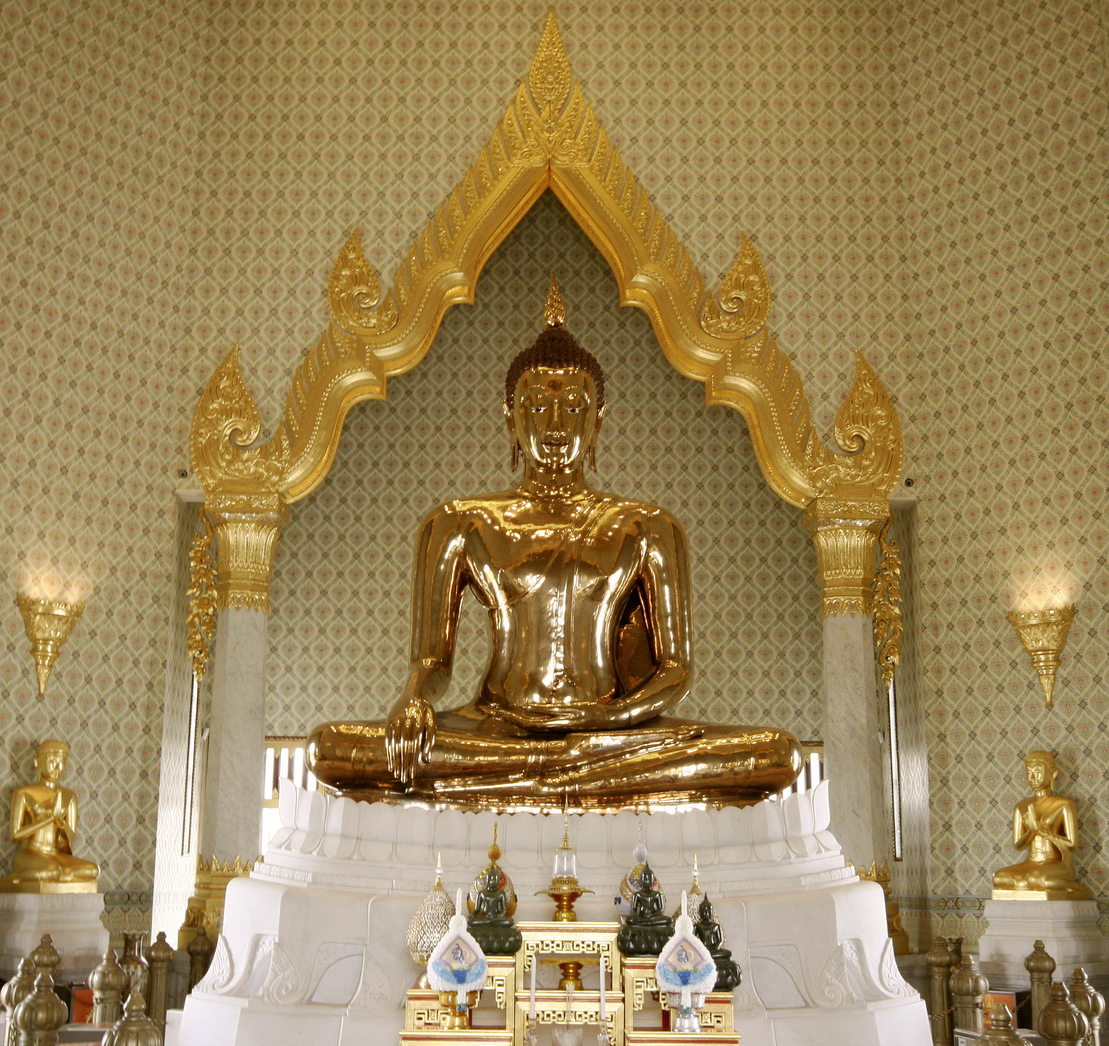
The Golden Buddha at Wat Traimit, Bangkok.
English spellings vary (Guinness writes “Suwan”, and the temple’s full name, Wat Traimit Witthayaram Worawihan or วัดไตรมิตรวิทยารามวรวิหาร, also turns up as “Trai Mit”). Thai people tend to use warmer, shorter names. You’ll hear หลวงพ่อทองคำ (lǔangpɔ̂ɔ tɔɔngkam), a familiar way of saying “the revered golden Buddha”, and พระสุโขทัยไตรมิตร (Phra Sukhothai Traimit), which names both its style and its temple. The temple was once called Wat Sam Chin (วัดสามจีน) and took its present name in 1940. Traimit means roughly “three friends”.
The image is about 3 metres tall and weighs about 5.5 metric tonnes. If you read 3.91 metres elsewhere, that measurement includes the base and the flame on top of the head.
Solid gold is the whole point. Thailand has far bigger Buddha images, but they’re built from other materials and covered in gold. So this isn’t the world’s largest Buddha. It’s the largest one made of solid gold. You’ll often read that the gold is purer in the head and topknot than in the body, with exact percentages attached. We haven’t found a primary source for those figures, so treat them as something guides like to repeat rather than a measured fact.
Today the image sits on the top floor of the Phra Maha Mondop, a white marble hall that opened in 2010. The floors below hold an exhibition on the statue’s history and the Yaowarat Chinatown Heritage Center. For many visitors the Golden Buddha is a record-breaker. For the Thai families kneeling in the hall, it’s a Buddha image they’ve come to pay respect to, and that’s worth a moment’s thought before you raise your phone.
How the Gold Stayed Hidden, and How It Was Found
Nobody knows exactly when the Golden Buddha was made or who covered it in plaster, but the most likely reason was to hide it from thieves or invading armies. The gold was found by accident on 25 May 1955, when the statue was being moved at Wat Traimit and some of the plaster broke away after it fell or was dropped.
The style points to the Sukhothai kingdom, which Guinness dates from 1238 to 1438, but there’s no record of the year the image was cast. Historians think it was probably moved from Sukhothai to Ayutthaya, and that the plaster went on at some point before Ayutthaya fell to Burmese armies in 1767. Painted stucco set with bits of coloured glass made it look like one more ordinary Buddha image. It worked so well that people forgot what was inside.
In the early 19th century the still-plastered image was installed at a Bangkok temple called Wat Chotanaram, also known as Wat Phraya Krai, on land near today’s Asiatique. When that temple fell into disrepair, the statue came to Wat Traimit in 1935. The temple had no hall big enough for it, so for about 20 years five and a half tonnes of gold sat under a simple tin roof, and nobody had any idea.
The Day the Plaster Cracked
By 1955 a new building was ready, and on 25 May workers tried to lift the image into it. The story goes that the ropes snapped and the statue dropped hard to the ground. Accounts of exactly what happened differ, and Guinness simply says it was accidentally dropped, but they all agree on what came next. Some of the plaster cracked away, and underneath it was gold.
Work stopped, and the rest of the plaster was removed slowly and carefully. Photographs of that process, and pieces of the plaster itself, are shown at the temple today. It also turned out that the image was cast in sections that fit together and can be taken apart. Sources don’t agree on how many, so we’ll leave it there.
The timing mattered too. The discovery came shortly before Thai Buddhists marked 2,500 years since the Buddha’s passing, and many saw it as deeply meaningful. You’ll also find dollar valuations online, but they date as fast as the gold price moves, so take them with a pinch of salt.
How to Visit Wat Traimit
Wat Traimit is at 661 Charoen Krung Road, Talat Noi, Samphanthawong, on the eastern edge of Chinatown and a short walk from MRT Hua Lamphong. It’s a working temple, so dress modestly, take your shoes off in the halls, and check the current opening hours and ticket prices before you go.
Getting There
Take the MRT Blue Line to Hua Lamphong. Many guides suggest Exit 1, then a walk of five to ten minutes towards the Chinatown Gate at Odeon Circle, where Yaowarat Road begins. MRT Wat Mangkon also works if you’re already in the middle of Chinatown, but it’s a longer walk, and neither the station nor the Chinese temple Wat Mangkon Kamalawat is Wat Traimit. If you take a taxi, showing the driver วัดไตรมิตร (wát dtrai mít) in Thai script is usually easier than pronouncing it.
Opening Hours and Tickets
The Tourism Authority of Thailand lists the temple as open daily from 08:00 to 17:00, and most 2026 visitor guides say the same. The exhibition floors are widely reported to be closed on Mondays, while the Golden Buddha hall usually stays open every day. Foreign visitors pay a small fee for the hall, and the exhibition floors are a separate ticket. Recent guides don’t agree on the price (you’ll see anything from 40 to 100 baht quoted for the hall), so treat any number online as a rough guide and check at the entrance. Thai visitors are usually admitted to the hall free.
What to Wear and How to Behave
Cover your shoulders and knees, take your hat off, and leave your shoes at the door of the halls. The Tourism Authority of Thailand’s temple guidance also rules out shorts, short skirts, sleeveless tops and see-through clothes. Inside, keep your voice low, don’t point your feet towards the Buddha image, and give people who are praying some space.
You may see Thai visitors kneel and bow down to the floor three times. That’s กราบ (gràap), and nobody expects you to copy it. A simple ไหว้ (wâai), palms together, is always welcome. Photography rules can change, so follow the signs on the day, skip the flash, and ask if you’re not sure.
Inside the Phra Maha Mondop
The Golden Buddha is on the top floor. The two floors below hold an exhibition on the statue’s history, including photographs from 1955, and the Yaowarat Chinatown Heritage Center, which tells the story of the Chinese families who shaped this part of Bangkok. If they’re open, both are worth the extra time. Allow 30 to 45 minutes for the hall alone. The courtyard and older buildings are usually free to walk around. If the heritage centre leaves you curious, our guide to Chinese influence in Thailand picks up the story.
Walking On to Chinatown
Yaowarat starts almost at the temple’s doorstep, so the two fit together naturally. If you’re carrying on into Chinatown, our guide to Bangkok’s Chinatown covers what to see, eat and say there. Late afternoon works well, because the temple usually closes at 17:00, just as the street food stalls begin to set up.
Thai Words for Your Visit to Wat Traimit
A few short Thai words will help you find the temple, read the signs and show respect in the hall. You don’t need a speech, and a smile does a lot of the work.
The marks on the romanisation show each syllable’s tone, and our beginner’s guide to Thai pronunciation explains how they work. To sound polite, men end a sentence with ครับ (kráp) and women with ค่ะ (kâ), which becomes คะ (ká) in a question. The When to Use It column says where to add them. For more on asking nicely, check out our guide to being polite in Thai.
| Thai | Romanisation | English | When to Use It |
|---|---|---|---|
| วัดไตรมิตร | wát dtrai mít | Wat Traimit | The temple’s everyday name. Show it in Thai script to a taxi driver. |
| หลวงพ่อทองคำ | lǔangpɔ̂ɔ tɔɔngkam | The Golden Buddha | A familiar name for the image, which is what many Thais call it. ทองคำ (tɔɔngkam) on its own means gold. |
| เยาวราช | yaowarâat | Yaowarat, Bangkok’s Chinatown | To ask for Chinatown, or say you’re walking on there next. |
| หัวลำโพง | hǔalampoong | Hua Lamphong | The nearest MRT station, and an area every taxi driver knows. |
| ไหว้ | wâai | To greet or pay respect with palms together | Always polite in the hall. You don’t need to do more. |
| กราบ | gràap | To bow down to the floor in respect | You’ll see worshippers do this. Visitors aren’t expected to. |
| ถอดรองเท้า | tɔ̀ɔt rɔɔngtáao | Take off your shoes | On signs and from staff at the hall doors. |
| ถ่ายรูปได้ไหม | tàai rûup dâai mái | Can I take a photo? | Ask before photographing people. Add ครับ (kráp) or คะ (ká). |
| ห้ามถ่ายรูป | hâam tàai rûup | No photography | A sign to recognise and follow. |
| ค่าเข้าชม | kâa kâo chom | Admission fee | On the price board at the ticket desk. |
| เปิดกี่โมง | bpə̀ət gìi moong | What time does it open? | For staff or a nearby shop. Add ครับ (kráp) or คะ (ká). |
| วัดอยู่ที่ไหน | wát yùu tîinǎi | Where is the temple? | When you’re close but can’t see the gate. Add ครับ (kráp) or คะ (ká). |
Words like these are how a city starts to feel like yours. At Duke Language School we’ve taught Thai in Bangkok since 2013, and the idea behind every class is the same: learn the Thai you’ll actually use, in the places you’ll actually use it. If that sounds useful, have a look at our Thai courses, or private Thai lessons if you’d rather learn one to one.
Frequently Asked Questions About the Golden Buddha
What Is the Golden Buddha at Wat Traimit?
The Golden Buddha at Wat Traimit in Bangkok is a seated solid gold Buddha image, officially named Phra Phuttha Maha Suwanna Patimakon, recognised by Guinness World Records as the world’s largest solid gold sculpture.
Is the Golden Buddha Really Solid Gold, and How Much Does It Weigh?
Yes, the Golden Buddha is a solid gold image weighing about 5.5 metric tonnes and standing about 3 metres tall, in the Sukhothai style. Much larger Buddha images exist in Thailand, but they’re covered in gold rather than made of it.
How Was the Golden Buddha Found?
The gold was found on 25 May 1955, when the plaster-covered statue was being moved at Wat Traimit and some of the plaster broke away after it fell. The story goes that the lifting ropes snapped.
How Do I Visit Wat Traimit?
Wat Traimit is at the eastern edge of Bangkok’s Chinatown, a short walk from MRT Hua Lamphong. Dress modestly, take your shoes off in the halls, and check the current opening hours and ticket prices before you go, because they can change.
What Is the Golden Buddha Called in Thai?
The official Thai name is พระพุทธมหาสุวรรณปฏิมากร (Phra Phuttha Maha Suwanna Patimakon). People also say หลวงพ่อทองคำ (lǔangpɔ̂ɔ tɔɔngkam) or พระสุโขทัยไตรมิตร (Phra Sukhothai Traimit), and the temple itself is วัดไตรมิตร (wát dtrai mít).
Sources and Further Reading
The facts in this article were checked against the sources below in November 2026. Opening hours and prices change, so please check before you visit.
Guinness World Records: Largest Solid Gold Sculpture
The record entry for the Golden Buddha, with its official name, Sukhothai-era style, plaster coating, the 25 May 1955 discovery, and its size and weight.
Read the Guinness World Records entry
Tourism Authority of Thailand: Top 5 Must-visit Temples in Bangkok
The temple’s address, the layout of the Phra Maha Mondop, opening hours, and dress guidance for temple visits.
Read the Tourism Authority of Thailand article
Wikipedia: Golden Buddha (statue) and Wat Traimit
Background on the statue’s move from Wat Chotanaram to Wat Traimit in 1935, the tin roof years, the temple’s earlier name, and the hall that opened in 2010.
Read about the Golden Buddha and read about Wat Traimit
Visitor Guides for 2026
Recent visitor guides on Monday closures of the exhibition floors and current ticket prices, which is where the different figures for the hall come from.
Read the IDC Travel guide and read the Thailand Life Tools page
Further Reading From DLS
If you’re planning a day around Wat Traimit, or just want more of the Thai behind it, these articles are a good next step.
Is Bangkok Home to the World’s Biggest Chinatown?
Why Yaowarat is often called one of the world’s largest Chinatowns, and how to make the most of a visit.
Chinese Influence in Thailand: Food, Words and Everyday Life
Who the Thai-Chinese are, and the everyday Thai words and dishes that came from Chinese.
Pad Thai (ผัดไทย): Meaning, Origin, and How to Order It in Thai
Hungry after the temple? Here’s how to order Thailand’s famous noodle dish the way you like it.
Thai Pronunciation for Beginners: Tones, Vowels and Sounds You Need to Speak Clearly
The tones and sounds behind every word in the table above, explained from the start.
How to Be Polite in Thai: Requests, Refusals, and เกรงใจ (greeng-jai)
How Thai people ask, refuse and soften things, and why ครับ and ค่ะ are only the start.