Halloween and Ghosts in Thailand: A Guide to Thai Ghosts (ผี)
Six Thai ghosts every learner should know, where the beliefs come from, how Thai people really talk about them today, and the Thai words that let you join in when the ghost stories start.
By Arthit Juyaso (Bingo)
Principal and Curriculum Developer, Duke Language School
Author of Read Thai in 10 Days
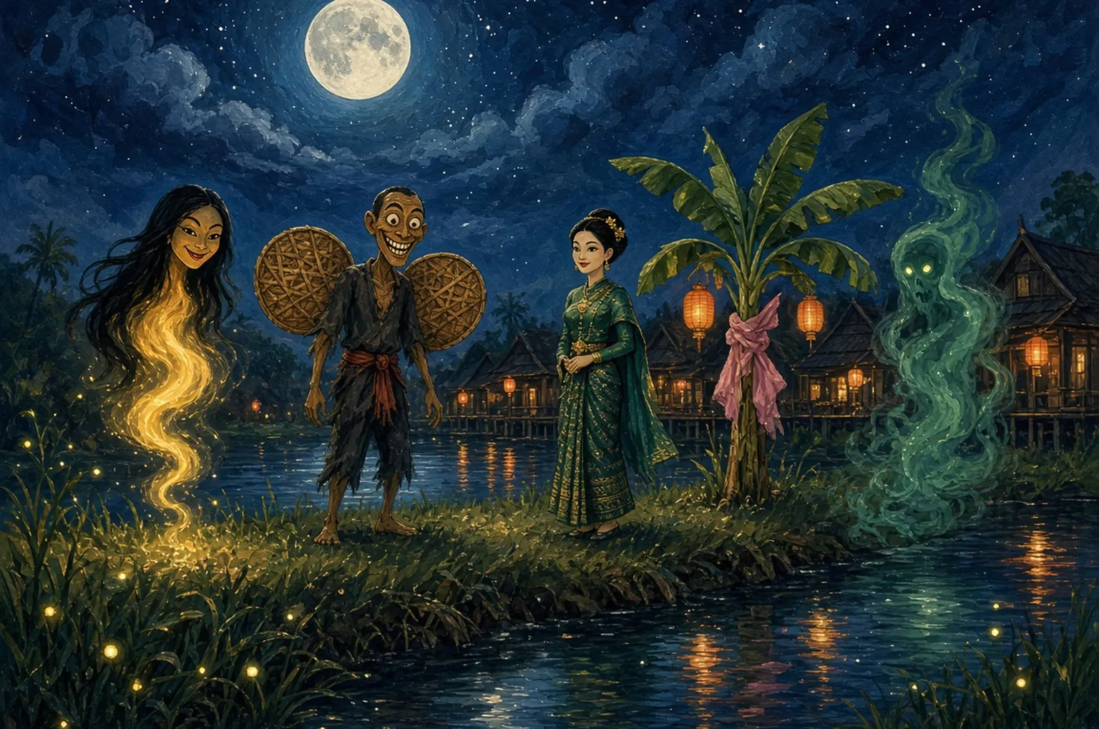
Thai ghosts, called ผี (pǐi), are a whole world of spirits, from frightening village ghosts to protective household spirits. The best known types of Thai ghosts include ผีปอบ (pǐi bpɔ̀ɔp), กระสือ (gràsʉ̌ʉ), ผีกระหัง (pǐi gràhǎng), นางตานี (naang dtaanii), ผีอำ (pǐi am) and เปรต (bprèet). They come from regional folklore, old Thai beliefs about spirits and Buddhist ideas about karma and rebirth. Not every Thai person believes in them, but almost everyone knows the stories.
Halloween in Thailand is mostly an imported party. Thai ghosts are not. They live in grandparents’ warnings, village gossip, temple murals, late-night TV and the little spirit house outside your condo. If you understand a few of them, you understand a surprising amount about Thai culture, and you pick up some very useful Thai along the way.
The Question I Get Every October
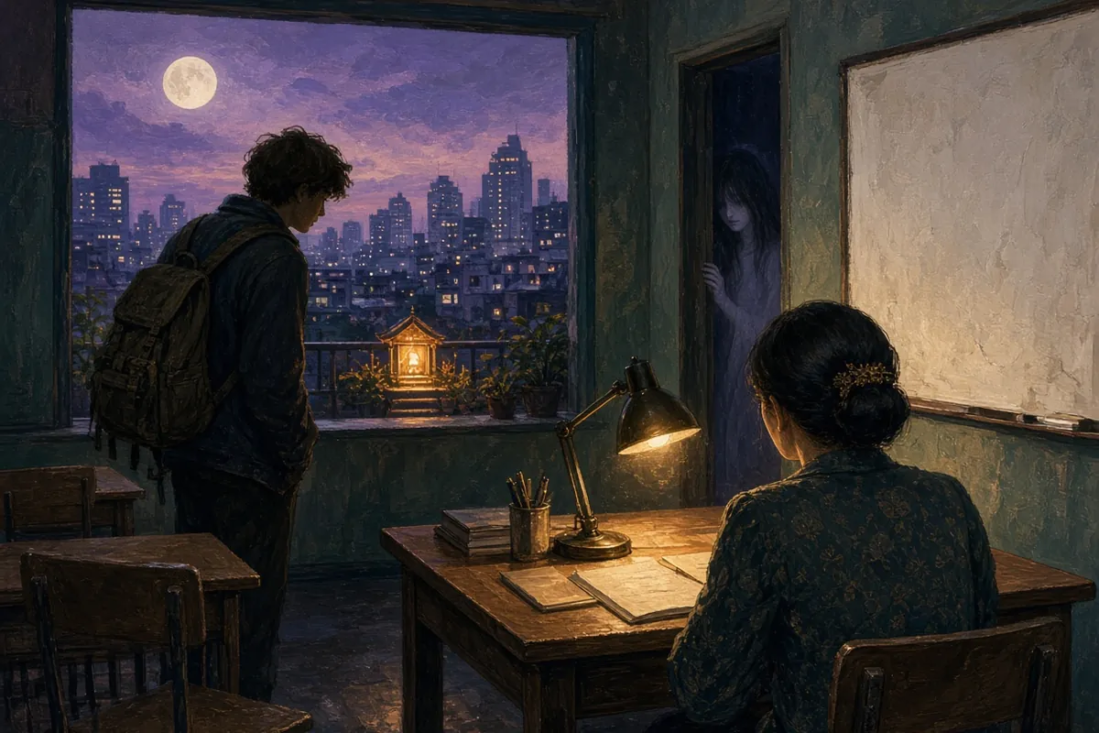
Every October, without fail, a student stays behind after class, waits until the room is empty and asks me, a little sheepishly, “Teacher, do Thai people actually believe in ghosts?” Usually something has prompted it. A coworker refused to stay late alone in the office. A landlord mentioned that a monk had blessed the flat. A Thai friend laughed at a horror film all the way through and then asked to be walked to her car.
My answer is always the same: some do, some don’t, and most people sit somewhere comfortably in the middle. What nearly everyone shares is the vocabulary. Thai children grow up with these ghosts the way British children grow up with witches and fairy tales, except that Thai ghosts never quite moved out of the stories and into the past. So when my students learn the names, they don’t just learn folklore. They learn how to follow a conversation at a Thai dinner table when someone lowers their voice and starts with “people say…”
That little phrase is worth learning before anything else, because nearly every Thai ghost story begins with it:
เขาว่ากันว่า
kǎo wâa gan wâa
“People say that…” or “They say that…”
Notice that it doesn’t commit the speaker to anything. It’s the perfect way to tell a ghost story without claiming it’s true, and you’ll hear it all through this guide.
Thai Ghosts (ผี): More Than a Tapestry of Fear
The first thing to know is that ผี (pǐi) is a much bigger word than the English “ghost.” Thai ghost beliefs include the spirits of the dead, but they also include spirits of places, households and ancestors. Some ผี are frightening, some are sad and some are protective. Thai cultural writers make the same point: in traditional belief there are good ผี as well as bad ones, such as the ancestral spirits a family looks after and the spirits that watch over a home.
These beliefs are also older and more layered than any one religion. Thai life mixes local spirit beliefs, Brahmin ritual and Buddhism, and they sit side by side quite happily. A person can go to the temple in the morning, leave a garland at the spirit house at lunchtime and refuse to whistle after dark, and nobody around them sees any contradiction. If you’ve already read our piece on why Thais won’t whistle at night, you’ve met this mix already.
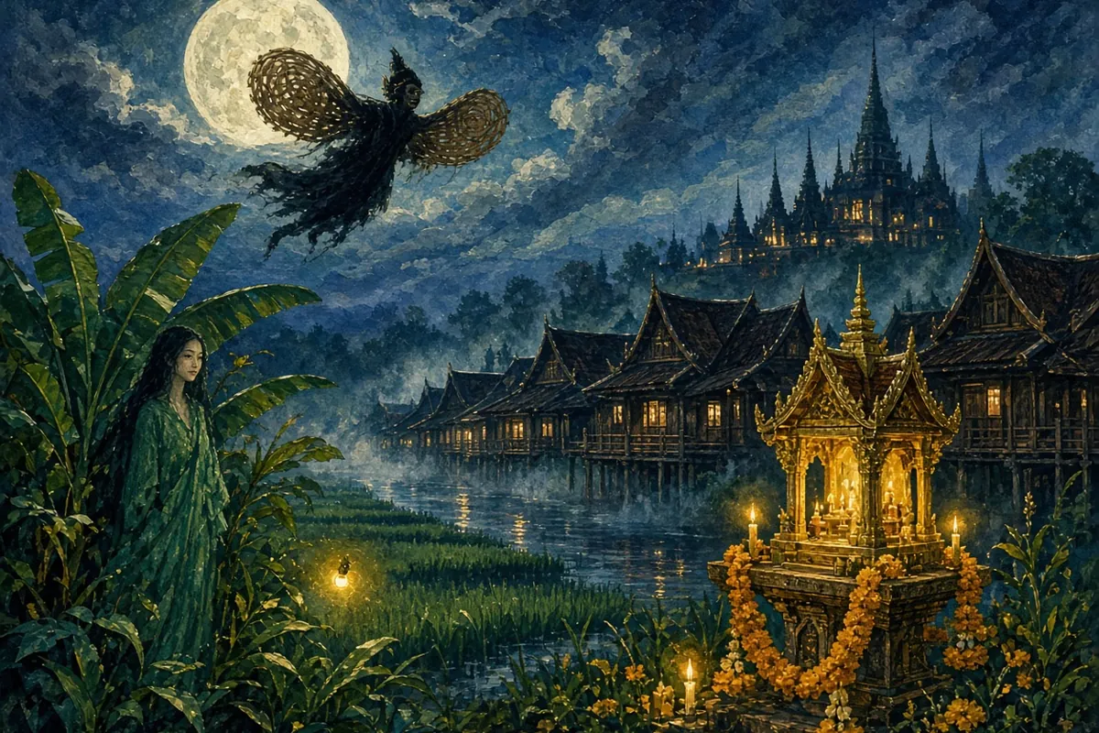
For a Thai learner, ghosts are also a brilliant way into the language. Ghost stories are full of everyday grammar, regional words and expressions you’ll hear long after Halloween in Thailand is over. Thai people use ghost words for jokes, for teasing and for describing ordinary feelings like fear, tiredness and embarrassment. Learn the ghosts, and you learn a little of how Thai people think and talk.
One important note before we start. Folklore changes from region to region and even from village to village, so treat everything below as “in many versions” rather than an official rulebook. If a Thai friend tells you their grandmother’s version is different, believe the grandmother.
1. ผีปอบ (pǐi bpɔ̀ɔp): The Organ-Eating Spirit
If you spend any time in Isan, the northeast of Thailand, you’ll eventually hear about phi pop. In Isan folklore, ผีปอบ is a spirit said to live inside a living person and feed on their internal organs, or to slip out and feed on other people. The person it occupies may be a man or a woman. Horror films and costume shops love to show phi pop as a scary old woman, but that’s a screen habit rather than a rule of the belief.
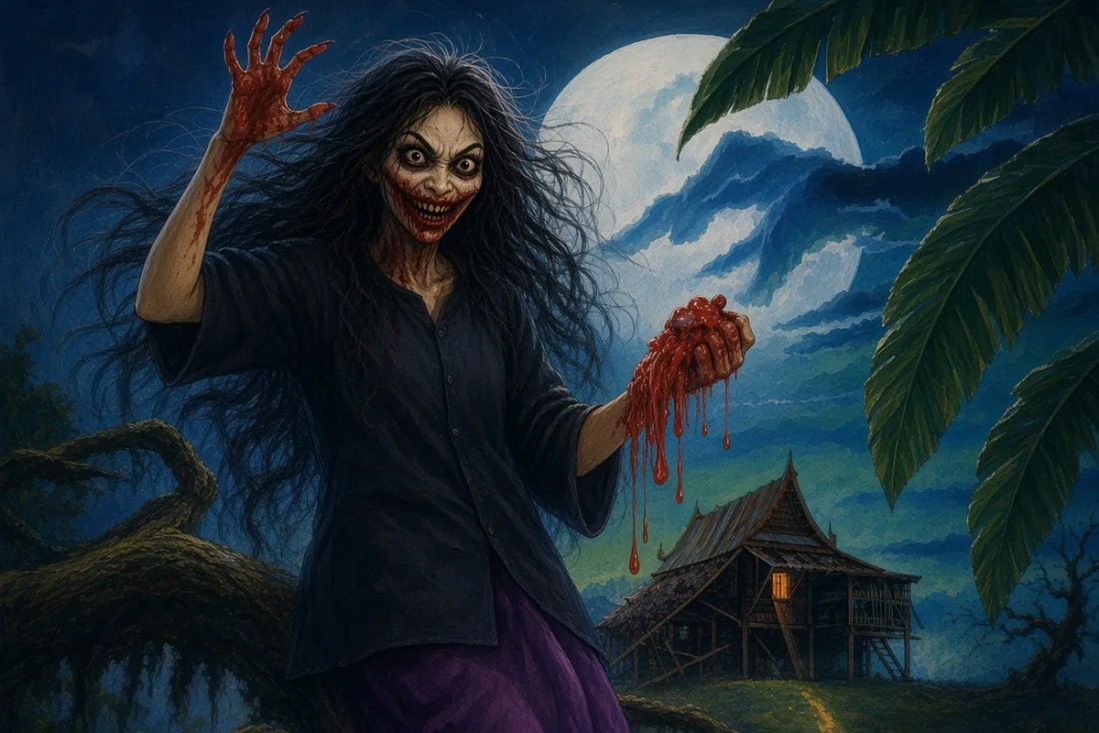
Where does a phi pop come from? In many versions, it starts with someone who studied magical knowledge, วิชาอาคม (wíchaa aakom), and then broke its rules or couldn’t control it. The power turns bad and becomes a ผีปอบ. In some villages, a ritual specialist called a หมอธรรม (mɔ̌ɔ tam) or หมอผี (mɔ̌ɔ pǐi) is called in to drive it out. Japanese anthropologist Tsumura Fumihiko has written about mo tham exorcists in northeast Thailand, alongside the region’s many kind and protective spirits.
What makes phi pop interesting today is that the belief hasn’t disappeared. Researchers at Mahidol University who studied phi pop stories found the belief still alive in parts of Isan, with older people more likely to believe and younger people more likely to question it. They also describe how the belief can work as a kind of social control, keeping people in line with community rules. Folklorist Kanya Wattanagun has written about how people in contemporary northeast Thailand experience and explain phi pop, which is a reminder that for some families this isn’t just a film monster. It’s a serious accusation.
So here’s how you’ll hear it in conversation. Practise the low tone on ปอบ, and if tones still feel slippery, have a look at our guide on how to pronounce Thai tones.
เขาว่ากันว่าหมู่บ้านนั้นมีผีปอบ
kǎo wâa gan wâa mùubâan nán mii pǐi bpɔ̀ɔp
“People say there’s a phi pop in that village.”
A friendly word of advice: enjoy the story, but don’t joke that a real person is a ผีปอบ. In a village, that kind of rumour can hurt someone badly.
2. ผีกระหัง (pǐi gràhǎng): The Ghost With Winnowing-Basket Wings
Next comes the strangest-looking Thai ghost of all. ผีกระหัง is a male ghost from Central Thai folklore who flies at night using two กระด้ง (gràdông), the flat round bamboo baskets used for winnowing rice, as wings. In many versions he uses สาก (sàak), rice pestles, as a tail or extra legs. It’s a ghost built straight out of a farmhouse kitchen.
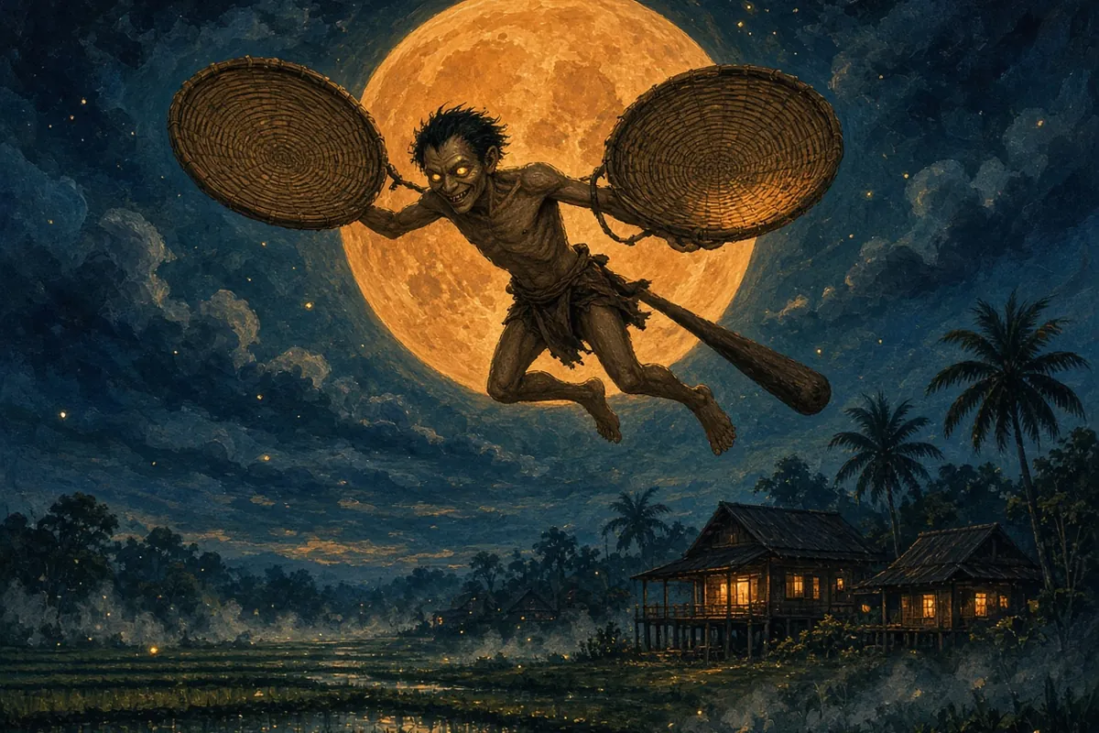
The krahang is old. Thai cultural writers point out that its earlier name, กระหาง (gràhǎang), appears alongside กระสือ in the old Thai legal code known as the Three Seals Law. Even the great Thai folklorist Phraya Anuman Rajadhon admitted that nobody seemed to know much about what the krahang actually did to people. Modern tellings fill the gap: people say a krahang is a man who practised black magic, ไสยศาสตร์ (sǎiyasàat), and lost control of it.
Today the krahang is usually paired with the krasue as a kind of ghostly couple. Old sources, even the Three Seals Law, name them side by side, but the love story between them is a modern addition. Here’s a fun language note for you, too. Phraya Anuman Rajadhon also wrote about how Thai sometimes adds a กระ (grà) sound to the front of words, and some writers think that’s how both กระหัง and กระสือ got their names. Treat that as an interesting theory rather than settled fact.
กระหังใช้กระด้งเป็นปีก
gràhǎng chái gràdông bpen bpìik
“The krahang uses winnowing baskets as wings.”
It sounds silly in English. Say it in Thai at a dinner table, though, and you’ll get a laugh and probably a story.
3. นางตานี (naang dtaanii): The Banana Tree Spirit
Not every Thai ghost wants to frighten you. นางตานี is the spirit of the กล้วยตานี (glûai dtaanii), a wild banana tree, and she’s usually described as a beautiful young woman dressed in green. Older Thai accounts describe her with long hair, a sweet scent and lips the red of a ripe ivy gourd. People sometimes leave small offerings at banana trees believed to be hers, or tie coloured cloth around the trunk.
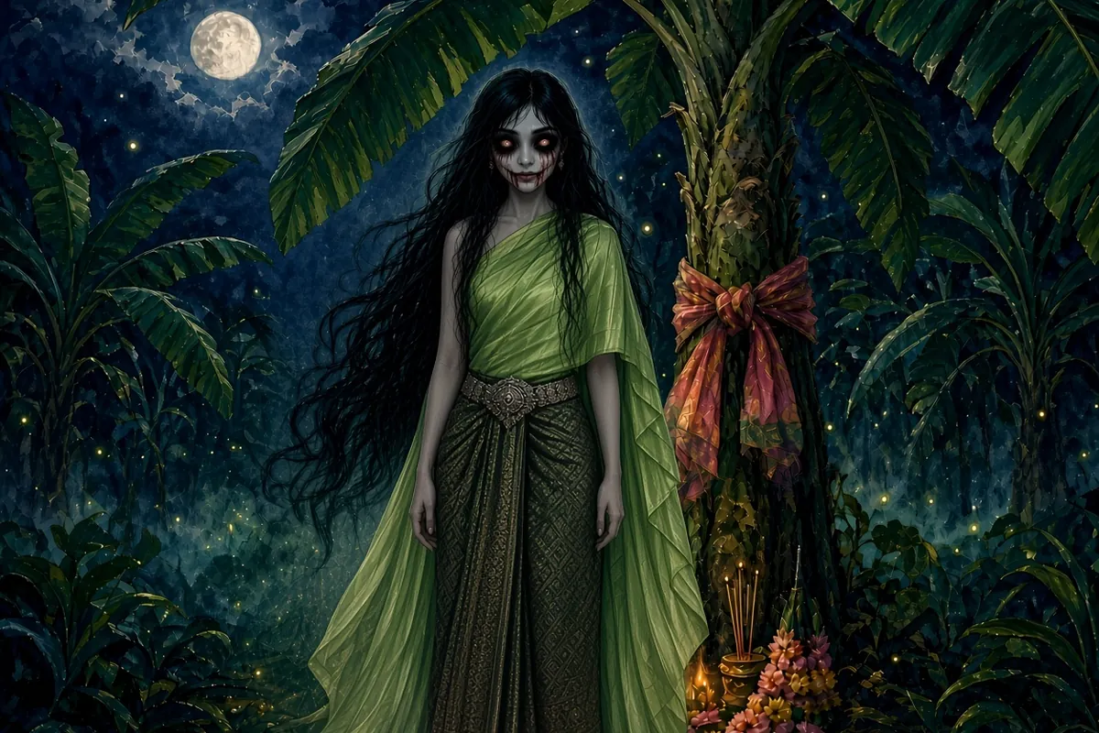
There’s also a well-known rule: don’t plant กล้วยตานี next to your house. Some older Thais still call it กล้วยผี (glûai pǐi), “ghost banana.” Interestingly, there’s a very practical explanation. A banana craftsman interviewed by Post Today explained that when กล้วยตานี is planted with the eating bananas people grow at home, the other bananas start producing seeds. A ghost story was simply a memorable way of keeping the wild banana away from the kitchen garden.
So is Nang Tani good or bad? In most tellings she’s gentle and keeps to herself, and some stories even describe her as protective. In some versions, though, she lures men, and a man who takes her as a spirit wife and then strays is in real danger. She’s probably best described as a spirit you should respect rather than fear.
อย่าปลูกกล้วยตานีไว้ใกล้บ้าน
yàa bplùuk glûai dtaanii wái glâi bâan
“Don’t plant a tani banana near the house.”
4. กระสือ (gràsʉ̌ʉ): The Floating Head
If you’ve seen a single Thai horror poster, you’ve probably seen the krasue. In Central Thai folklore, กระสือ is a female ghost whose head leaves her body at night and floats through the dark with her internal organs hanging below. From a distance, people say, all you see is a flickering light. During the day, she looks like an ordinary woman. Older descriptions often make her an old woman, while modern films tend to prefer a young and beautiful one.
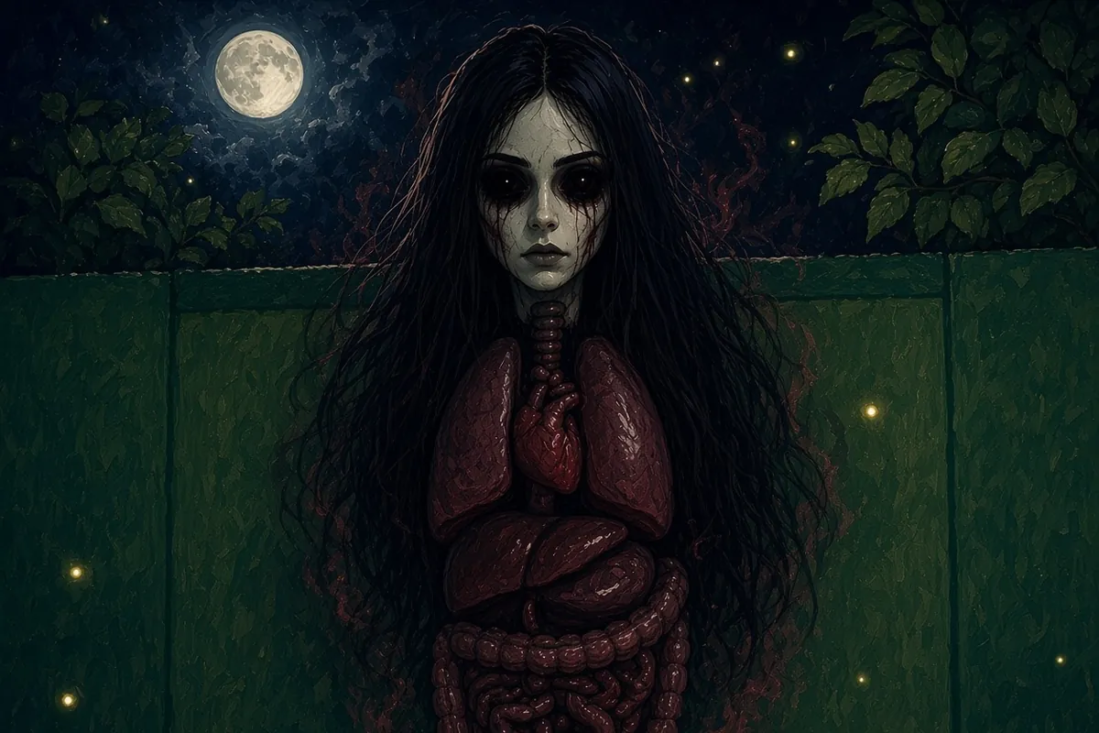
The krasue is one of the oldest Thai ghosts on record. Like the krahang, she’s named in the Three Seals Law, which tells you she has been part of Thai life for centuries. According to Phraya Anuman Rajadhon, the krasue loves fresh, raw and bloody food, which is why she was believed to threaten women who had just given birth. Families would pile thorny branches under the house to keep her away, because she was afraid the thorns would snag her entrails. In the North and Isan, a similar night-glowing ghost is known as ผีโพง (pǐi poong), and similar floating-head spirits appear in neighbouring countries too.
My favourite krasue detail is about laundry. In many versions, after a krasue has eaten something filthy, she wipes her mouth on any clothes left out on the line overnight, leaving stains. Phraya Anuman Rajadhon offered a sensible explanation: those stains are most common in the rainy season, so they were probably mildew. Blaming the krasue was a good way to make sure nobody left the washing out all night. That’s Thai folk wisdom at its best: a ghost story doing the job of a household rule.
อย่าตากผ้าทิ้งไว้ข้ามคืน
yàa dtàak pâa tíng wái kâam kʉʉn
“Don’t leave the laundry out overnight.”
The krasue still turns up in the news now and then. Thai PBS once reported a village krasue scare that turned out to be a chicken thief in a mask, which is perhaps the most Thai ending a ghost story could have.
5. ผีอำ (pǐi am): The Ghost That Holds You Down
This is the ghost my students recognise most often, even if they’ve never heard of it. You wake up in the night, you’re fully aware of the room, but you can’t move or speak, and it feels as if something is pressing down on your chest. In Thai, that experience is called ผีอำ (pǐi am), and the Thai dictionary describes it as dreaming that someone is holding or wrestling you down until you wake up exhausted.
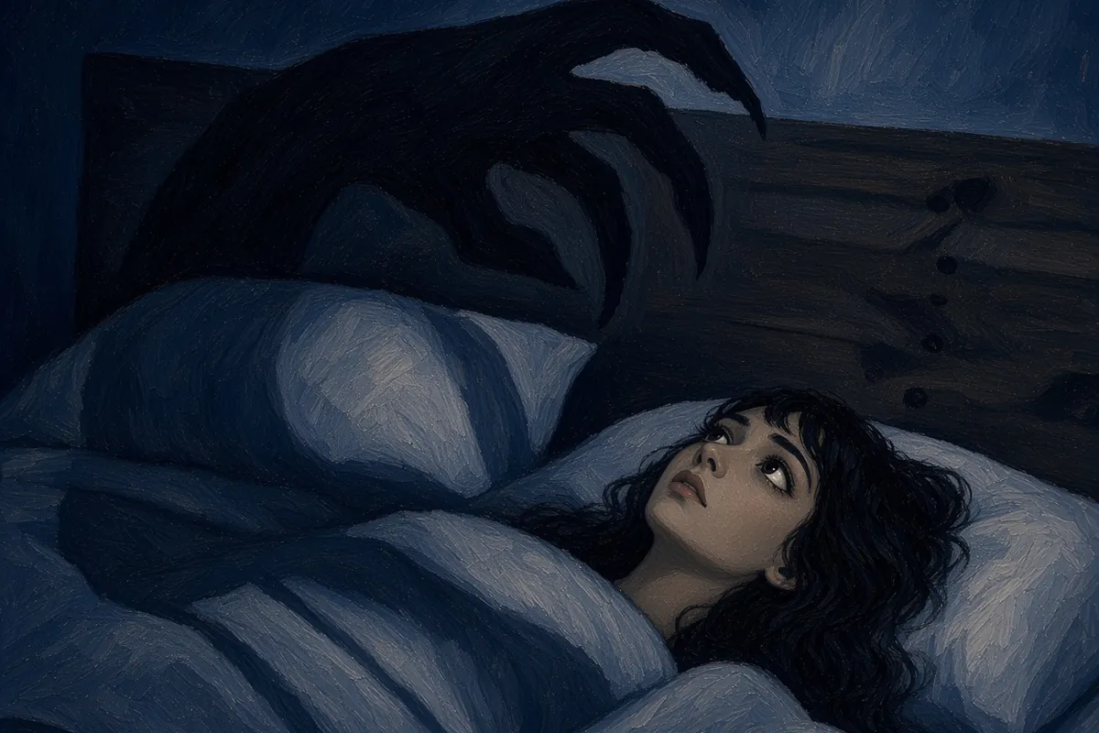
Doctors call it sleep paralysis, and Thai media regularly explain it that way, linking it to stress, tiredness and irregular sleep. Plenty of Thai people know the science perfectly well and still say ผีอำ, the same way English speakers still say “the sun rises.” It’s simply the everyday word. Others are quite sure a spirit was involved, and some people will tell you to make merit or say a prayer if it keeps happening.
Here’s how you’d describe a bad night:
เมื่อคืนโดนผีอำ
mʉ̂a kʉʉn doon pǐi am
“I had a ghost holding me down last night.” or “I had sleep paralysis last night.”
And here’s a bonus. In casual modern Thai, อำ (am) on its own also means to tease someone or trick them into believing something. So when a friend tells you a story that sounds too wild to be true, you can say:
อย่ามาอำ
yàa maa am
“Don’t pull my leg.”
It’s informal, so keep it for friends rather than your boss.
6. เปรต (bprèet): The Hungry Ghost
The last ghost on our list comes from Buddhism rather than village folklore. A เปรต (bprèet), from the Pali word peta, is a being reborn in one of the unhappy realms of Buddhist cosmology because of bad karma, often greed or meanness in a previous life. So a เปรต isn’t a spirit that hasn’t been reborn yet. Being a เปรต is itself a rebirth, in a realm of constant hunger and thirst.
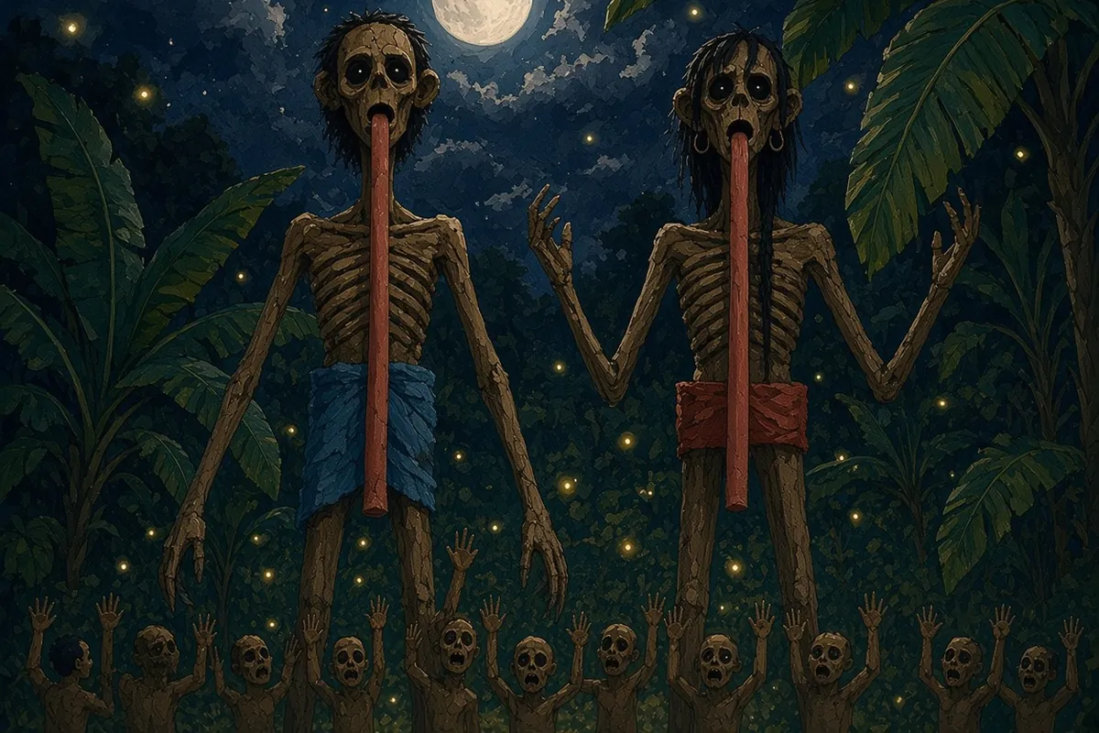
Thai art usually shows เปรต as extremely tall and thin, with a huge belly and a mouth as small as the eye of a needle, so they can never eat enough. Some Thai temples and Buddhist parks display tall เปรต statues as a moral lesson, and you’ll see them in temple murals too. Their image is so familiar that a very tall, skinny person may get teased with the expression สูงเป็นเปรต (sǔung bpen bprèet), “as tall as a preta.” It’s a tease between friends, so don’t use it on anyone you’ve just met.
The เปรต is also at the centre of one of southern Thailand’s biggest festivals. During สารทเดือนสิบ (sàat dʉan sìp), in the tenth lunar month (usually around September or October), people in Nakhon Si Thammarat and across the South make merit for their ancestors and for any relatives who may have been reborn as เปรต. Offerings are placed on raised platforms for the hungry ghosts, and afterwards people take part in ชิงเปรต (ching bprèet), cheerfully scrambling for the offerings, which many believe brings good luck and merit.
ทำบุญให้บรรพบุรุษ
tam bun hâi banpabùrùt
“To make merit for your ancestors.”
Thai Ghost Beliefs and Superstitions
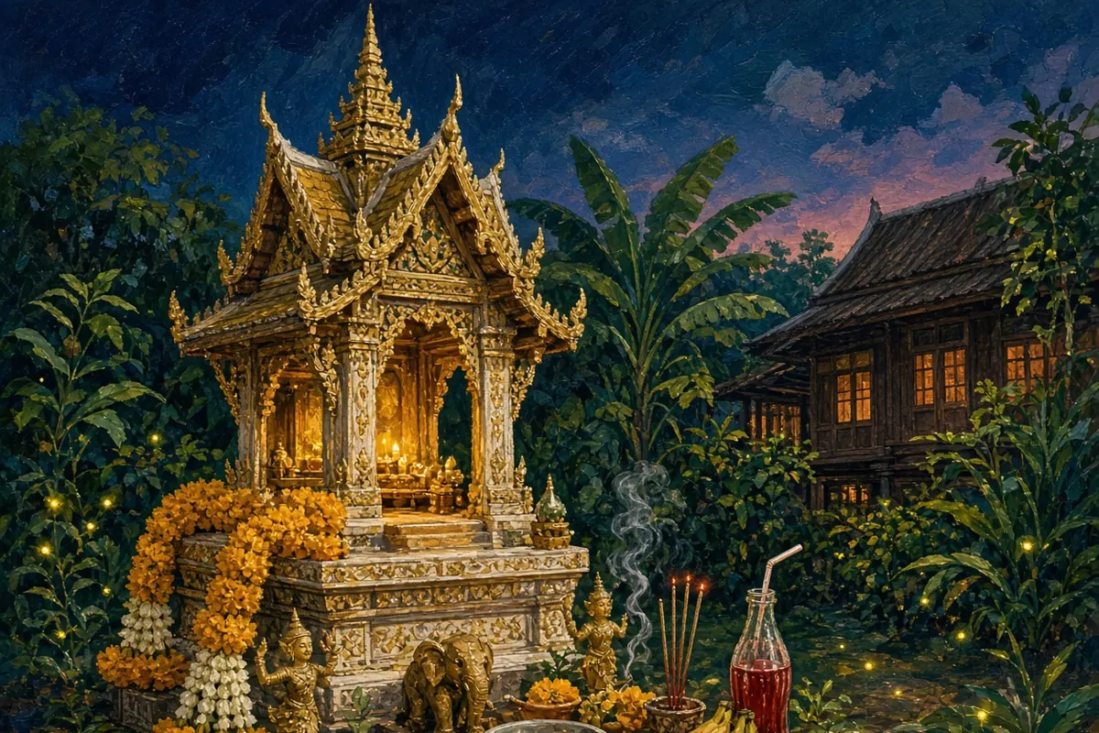
Most Thai ghost beliefs you’ll actually meet in daily life are quiet and practical rather than dramatic. People make merit, ทำบุญ (tam bun), and dedicate it to the dead. They look after the spirit house, ศาลพระภูมิ (sǎan prápuum), outside homes, shops and offices. Some keep protective objects, such as Thai spirit cloths (ผ้ายันต์), framed above a door. And many follow small household rules, like not whistling at night, that are half habit and half respect. Our post on why Thais won’t whistle at night explains that one in detail.
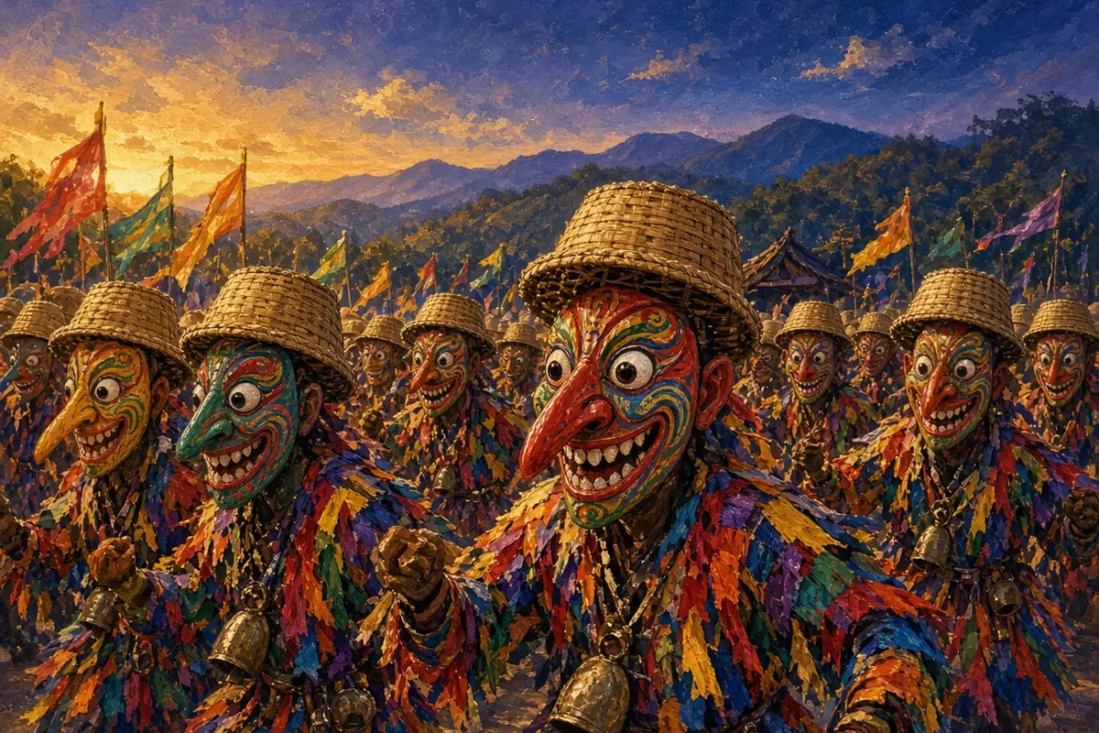
Thailand also has a famous ghost parade, but it isn’t a Halloween-style ghost festival. ผีตาโขน (pǐi dtaa kǒon) is part of the Bun Luang festival in Dan Sai, Loei, held around June or July. Villagers parade in tall, colourful masks carved from the thick base of coconut palm fronds and topped with sticky-rice steamers, and the festival also includes Buddhist sermons on the story of Prince Vessantara and plenty of merit-making. It’s joyful, noisy and deeply local, and it shows how Thai ghosts and Buddhist practice happily share the same weekend.
Haunted Locations in Thailand
Every Thai city has its haunted hospitals, abandoned buildings and “don’t go there after dark” roads. If you’re curious, we’ve collected a few of the best-known haunted places in Bangkok. Just remember that Mae Nak’s shrine at Wat Mahabut is a working place of worship, not a haunted attraction, so visit it the way you’d visit any temple.
Thai Ghosts on Screen
Thai cinema has been bringing these ghosts to life for decades, and films are how most people in Bangkok meet a krasue or a phi pop today. That’s also why screen versions don’t always match village beliefs: a film needs a scary face and a twist, not a grandmother’s careful explanation. Watching Thai horror with Thai subtitles is still one of my favourite homework suggestions, because ghost films are full of the everyday words in this guide.
Thai Ghost Words to Learn
You now know six famous ghosts. Here are a few more words that turn up whenever Thai people talk about spirits, so you can follow the conversation and react naturally.
กลัวผี (glua pǐi): Scared of Ghosts
The simplest and most useful one. It’s completely normal for adults to admit it in Thailand, so you might hear:
กลัวผีมั้ย
glua pǐi mái
“Are you scared of ghosts?”
An honest “นิดหน่อย (nítnɔ̀i)”, “a little”, is always a good answer.
ผีเข้า (pǐi kâo): Possessed
Literally “a ghost enters.” It’s used for spirit possession in stories, but people also use it jokingly when someone suddenly acts wild or out of character:
วันนี้เป็นอะไร ผีเข้าเหรอ
wanníi bpen arai, pǐi kâo lə̌ə
“What’s up with you today? Are you possessed?”
เจ้าที่ (jâotîi): The Guardian Spirit of a Place
เจ้าที่ is the spirit believed to look after a particular piece of land or building. Some Thais politely ask its permission before doing something on unfamiliar ground, like camping or relieving themselves outdoors:
ขออนุญาตเจ้าที่
kɔ̌ɔ anúyâat jâotîi
“Asking permission from the guardian spirit.”
ศาลพระภูมิ (sǎan prápuum): Spirit House
The little house on a pillar outside homes and buildings. If you want to ask about one politely:
ศาลพระภูมินี้ตั้งมานานหรือยัง
sǎan prápuum níi dtâng maa naan rʉ̌ʉ yang
“Has this spirit house been here long?”
ทำบุญ (tam bun): To Make Merit
Giving food to monks, donating to a temple or doing a good deed. It’s also how many Thai people take care of the dead:
พรุ่งนี้จะไปทำบุญที่วัด
prûng níi jà bpai tam bun tîi wát
“Tomorrow I’m going to make merit at the temple.”
กรวดน้ำ (grùat náam): Pouring Water to Share Merit
After making merit, many Thais slowly pour water from a small vessel while monks chant, dedicating the merit to relatives who have died and to other beings. You might be invited to join:
มากรวดน้ำด้วยกัน
maa grùat náam dûai gan
“Come and pour the water with us.”
Learn these and you’ll notice ghost and spirit words everywhere: in offices, on building sites, at temples and in every Thai horror film you watch.
Share the Shiver, Respect the Belief
So this October, enjoy Halloween in Thailand, dress up as a krasue if you like and swap ghost stories with your Thai friends. Just keep the same line Thai people keep themselves: film monsters and costumes are fun, but real shrines, real accusations and real grief deserve respect. You don’t have to believe in ผี to understand why they matter to the people around you.
If you’d like to understand the stories when the lights go down and someone starts with เขาว่ากันว่า, that’s exactly the sort of everyday Thai we teach. Have a look at our Thai courses at DLS and come and practise with us. We take Thai seriously, but never too seriously. Fun is our serious business, even when the ghosts come out.
Frequently Asked Questions About Thai Ghosts
What Are the Most Famous Thai Ghosts?
The best known include ผีปอบ (pǐi bpɔ̀ɔp), กระสือ (gràsʉ̌ʉ), ผีกระหัง (pǐi gràhǎng), นางตานี (naang dtaanii), ผีอำ (pǐi am) and เปรต (bprèet), along with the legendary Mae Nak of Phra Khanong. Some come from regional folklore, such as phi pop from Isan, while เปรต comes from Buddhist teaching about rebirth. Thai films and TV have made most of them familiar across the whole country.
What Is a Phi Pop (ผีปอบ)?
In Isan folklore, a phi pop is a spirit said to live inside a person, man or woman, and feed on human organs. In many versions it comes from someone who misused or lost control of magical knowledge, and a ritual specialist may be called to drive it out. Researchers have found that the belief is still alive in parts of northeast Thailand, especially among older people.
What Is a Krasue (กระสือ)?
A krasue is a female ghost from Central Thai folklore whose head leaves her body at night, trailing her internal organs and glowing like a small light. People say she craves raw and bloody food, which is why thorny branches were once placed under houses where a woman had just given birth. She’s named in old Thai law and is one of the most famous Thai ghosts on screen today.
Is ผีอำ (pǐi am) the Thai Name for Sleep Paralysis?
Yes, in everyday Thai, ผีอำ is the usual way to describe what doctors call sleep paralysis: waking up unable to move, often with a feeling of pressure on the chest. The words literally suggest a ghost holding you down. Many Thai people know the medical explanation and still use the traditional word, while others believe a spirit is really responsible.
What Is a เปรต (bprèet), the Thai Hungry Ghost?
A เปรต is a being reborn in the hungry ghost realm of Buddhist cosmology because of bad karma, such as greed in a past life. It’s usually shown as very tall and thin, with a tiny mouth that can never take in enough food. During the southern festival of สารทเดือนสิบ (sàat dʉan sìp), people make merit and leave offerings for ancestors who may have been reborn as เปรต.
Is นางตานี (naang dtaanii) a Good or Bad Ghost?
Mostly good, or at least harmless if you treat her with respect. Nang Tani is the spirit of the wild banana tree, usually pictured as a beautiful woman in green, and in many stories she’s gentle or even protective. Some versions say she is dangerous to unfaithful men, so she’s a spirit to respect rather than fear.
Do Thai People Really Believe in Ghosts?
Some do, some don’t, and many sit somewhere in between. Even Thais who don’t believe usually show respect for spirit houses, shrines and family customs, and almost everyone knows the famous ghost stories. Researchers studying beliefs like phi pop have found that older people tend to believe more strongly than younger people, but the beliefs remain an everyday part of Thai culture.
About the Author
Arthit Juyaso (Bingo) is the Principal and Curriculum Developer at Duke Language School. He is also a Thai language educator and the author of Read Thai in 10 Days.
His teaching focuses on helping foreign learners understand not just Thai vocabulary and grammar, but also how the language works in everyday conversations. Through his work at Duke Language School, he develops practical Thai learning materials that connect language with the culture, customs, and ordinary experiences of living in Thailand.
Sources and Further Reading
The cultural explanations in this article draw on Thai folklore, published research and reporting by Thai cultural institutions and media. Folk beliefs vary by region, so these sources describe common versions rather than a single official account.
Asian Ethnology: The Phenomenology of Supernatural Belief: The Ravenous Spirit (phii pob) Belief Tradition in Contemporary Northeast Thailand
Kanya Wattanagun’s study of how people in northeast Thailand experience and talk about phi pop today.
Read the Asian Ethnology article
Journal of Language and Culture, Mahidol University: Phi-pob, A Remaining Discourse in the Digital Age
Research on how phi pop belief survives in Isan communities, how attitudes differ between generations and how the belief works as social control.
Read the Journal of Language and Culture article
Tōnan Ajia: Rekishi to Bunka (Southeast Asia: History and Culture) no. 40, 2011, Tsumura Fumihiko (in Japanese, English abstract)
An anthropological study of benevolent and malevolent spirits in northeast Thailand, including phi pop possession and exorcism.
Silpa-Mag: กระสือ-กระหัง, the Ghostly Couple of Old Thailand
A Thai-language article on krasue and krahang, their appearance in the Three Seals Law and Phraya Anuman Rajadhon’s explanations of the beliefs.
Journal of Humanities and Social Sciences, Phranakhon Si Ayutthaya Rajabhat University: ผีในกฎหมายตราสามดวง (Spirits in the Three Seals Law)
A Thai-language study of how spirits, including กระสือ and กระหัง, appear in the Ayutthaya-era Three Seals Law (PDF).
Thai PBS: เปิดจักรวาลผีไทย (Opening the Universe of Thai Ghosts)
A Thai-language overview of famous Thai ghosts, including krasue and krahang, and how the stories live on today.
Thai PBS: เปรต and สารทเดือนสิบ
Thai-language reporting on the Buddhist idea of เปรต, the southern Sart Duean Sip festival and the ชิงเปรต tradition.
Walailak University Library: ประเพณีสารทเดือนสิบ (The Sart Duean Sip Festival)
A Thai-language guide to the southern festival of the tenth lunar month in Nakhon Si Thammarat and the Buddhist ideas about เปรต behind it.
Read the Walailak University Library article
The Standard: ไขปริศนา ผีอำ (Solving the Mystery of ผีอำ)
A Thai-language explainer on ผีอำ and the science of sleep paralysis.
Post Today: The Tani Banana, From Belief to Fashion
A Thai-language feature on กล้วยตานี, why it was kept away from houses and how it became a craft material.
TruePlookpanya: ผีนางตานี (The Nang Tani Ghost)
A Thai-language article on the Nang Tani spirit, how older Thai texts describe her and why she is linked only to the wild banana.
Read the TruePlookpanya article
Tourism Authority of Thailand: Bun Luang and Phi Ta Khon Festival
Official information on the Phi Ta Khon parade, its masks and the Buddhist ceremonies of the Bun Luang festival in Dan Sai, Loei.
Fine Arts Department: Thai Beliefs About ผี
A Thai-language article from the Trang National Library explaining good and bad spirits in traditional Thai belief.
Read the Fine Arts Department article
Further Reading From DLS
If you enjoyed meeting Thailand’s ghosts, here are a few more articles about the beliefs, places and sounds that go with them.
Halloween in Bangkok: Why Won’t Thais Whistle at Night?
Why a harmless whistle can make your Thai friends nervous, plus the Thai words you’ll hear when the ghost stories start at a Halloween party.
9 Haunted Places in Bangkok You Didn’t Know About
From quiet housing estates to old buildings with a reputation, a tour of the Bangkok spots that locals talk about in lowered voices.
Thai Spirit Cloths (ผ้ายันต์)
Why many Thai people hang sacred cloths covered in script and symbols above their doors, and what they’re believed to protect against.