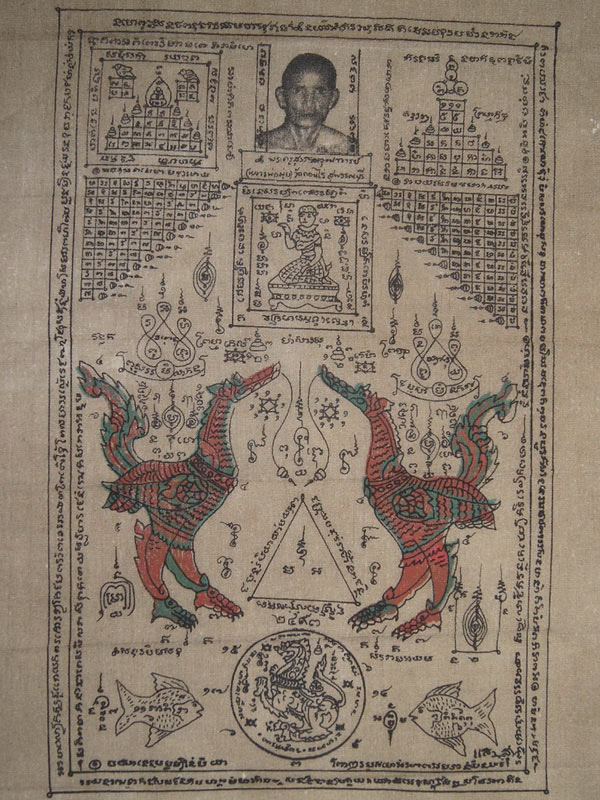
Pha yant (ผ้ายันต์, pâa yan) are Thai spirit cloths: squares of cotton printed or hand-drawn with sacred diagrams called ยันต์ (yan), usually made or blessed at a temple and kept for protection and good luck. You’ve almost certainly seen one already, even if you didn’t know what it was.
Look up the next time you buy noodles in Bangkok. Above the door of many family shops, there’s a faded square of cloth in a frame, covered in curly letters, numbers, tiny Buddha figures and the odd tiger. You’ll spot the same designs on the ceiling of a taxi, inside a wallet, or tied around a Muay Thai fighter’s arm. So what are they, and why do so many people trust a piece of cloth to look after them? Let’s find out.
Pha Yant at a Glance
| Question | Answer |
|---|---|
| What it is | A cloth printed or drawn with a yantra: sacred script, numbers, shapes and figures |
| Thai name | ผ้ายันต์ (pâa yan), literally “yantra cloth” |
| Where you’ll see it | Above shop and house doors, on walls, in cars and taxis, folded in wallets |
| What it’s for | Protection from danger and bad spirits, safe travel, good trade and good fortune |
| Who makes it | Monks and respected masters (อาจารย์), who draw or print it and then bless it |
What Does Pha Yant Mean? ผ้า + ยันต์
The name is two simple words. ผ้า (pâa) means cloth. ยันต์ (yan) comes from the Sanskrit word yantra, a sacred diagram believed to hold power. Put them together and you get a yantra on cloth, which is exactly what it is.
In English you’ll see it written several ways: pha yant, phayant, “yantra cloth” or “Thai spirit cloth”. Searchers sometimes mix it up with phra yant, too. The final ต์ in ยันต์ is silent, which is why Thais say “yan”, not “yant”.
The same word ยันต์ shows up in สักยันต์ (sàk yan), the famous yantra tattoos. Same tradition, different surface: one goes on cloth, the other goes on skin.
Why Thais Hang Spirit Cloths Above Doors
A door is where the outside world comes in, so it’s where many Thai households and businesses put their protection. A spirit cloth above the entrance is believed to keep out bad luck, danger and unwelcome ผี (pǐi), ghosts or spirits. For a shop, it’s also a quiet wish for steady customers and โชคลาภ (chôok lâap), good fortune.
Height matters too. In Thai culture, high places are respectful places, so a sacred cloth goes up, never down near the floor. That’s the same logic behind the spirit house, ศาลพระภูมิ (sǎan prá-puum), that stands on a raised post outside so many buildings. If you want to meet the spirits these charms are meant to keep away, start with our guide to Thai ghosts.
Not every Thai person believes a cloth can stop a ghost, of course. For many families, a pha yant above the door is part faith, part habit and part respect for whoever gave it to them. Removing it can feel a bit like throwing away a gift from your grandmother.
What the Symbols on a Pha Yant Mean
At first glance a pha yant looks like a puzzle. Up close, it’s built from a few repeating pieces:
- Khom script (อักษรขอม): an old script based on ancient Khmer writing, used to write Pali chants. In the north you may see Lanna script instead.
- Abbreviated chants (คาถา): short syllables that stand for longer Pali prayers, most of them asking the Buddha for protection.
- Shapes and grids: circles, triangles and squares, often filled with numbers. The Thailand Foundation explains that triangles can stand for the Triple Gem and squares for the four elements.
- Figures: Buddha images, monks, guardian deities, tigers, mythical birds and Hanuman, the monkey warrior from the Ramakien.
Common Types of Pha Yant
Each cloth is made for a purpose. Protection cloths are the most common, and some designs, such as ยันต์ตรีนิสิงเห (yan dtrii ní sǐng hěe), are popular for keeping spirits away. Others are made for safe travel, for trade and money, or for เมตตามหานิยม (mêetdtaa mahǎaníyom), the power to make people like and trust you.
Every temple and master has their own style, so two cloths with the same purpose can look completely different. That’s also why it’s best not to “read” a cloth you find online. The real meaning usually sits with the person who made it.

Who Makes Pha Yant? Monks, Masters and Blessings
Pha yant are usually made at Buddhist temples or by respected masters, called อาจารย์ (aajaan). Some are drawn by hand. Many are printed with carved wooden blocks or screens, which is why you’ll see the same design repeated at one temple.
A printed cloth isn’t considered finished yet. It still needs to be ปลุกเสก (bplùksèek), blessed or empowered through chanting, often on an auspicious day. Thai news reports on old temple collections describe masters choosing special dates, such as the full moon, to write their cloths.
If you want to see how big this tradition can get, Wat Tom Klang (วัดต๋อมกลาง) in Phayao keeps a museum of giant old yantra cloths, some reportedly more than two metres long. In Bangkok, temples often give pha yant in return for a small donation, and you’ll find them in the amulet markets too.
Pha Yant, Sak Yant and Other Thai Protective Charms
Pha yant belongs to a whole family of Thai protective objects. Once you know the names, you’ll start seeing them everywhere, from boxing rings to temple stalls.
| Thai name | What it is | Where you’ll see it |
|---|---|---|
| ผ้ายันต์ (pâa yan) | Yantra on cloth | Above doors, on walls, in cars and wallets |
| สักยันต์ (sàk yan) | Yantra tattoo | On the skin, often the back and shoulders |
| ประเจียด (bpràjìat) | Yantra cloth tied around the upper arm | Muay Thai fighters |
| มงคล (mongkon) | Sacred headband | Muay Thai fighters before a bout |
| ตะกรุด (dtàgrùt) | Rolled metal sheet with a yantra inside | Worn on a cord or around the waist |
| เสื้อยันต์ (sʉ̂a yan) | Shirt covered in yantra designs | Historically worn by soldiers going into battle |
A Short History of Thai Yantra Cloths
Historians generally trace yantras back to India, where they began as Hindu and Brahmanic sacred diagrams. As they travelled into Southeast Asia, often through Khmer tradition, they picked up Buddhist chants, Buddha images and local animal spirits. That mix is why a Thai pha yant can hold Pali prayers, Hindu deities and a tiger in the same square.
Cloth and clothing have long been part of this story. Thailand’s Fine Arts Department describes เสื้อยันต์, yantra shirts that soldiers wore for protection in war. Museums now keep cloths like these as cultural objects: Museum Siam has featured them in its collection on amulets and sacred objects, and the British Museum holds a Thai yantra cloth written in Khom script.
Researchers at the Siam Society have also looked at the older ideas behind these objects, from before amulets became the big business they are today. The short version: Thais were protecting themselves with sacred writing long before anyone sold it in a plastic bag.
How to Treat a Pha Yant Respectfully (and Can Foreigners Have One?)
Yes, foreigners can have a pha yant. Temples give them to anyone who makes a donation, and most Thais are happy to see visitors take an interest. What matters is how you treat it.
- Keep it high: on a wall, above a door or on a shelf.
- Don’t put it on the floor, sit on it or use it as a placemat.
- Don’t wear it as a costume or joke about it in front of people who take it seriously.
- If you want to know what yours is for, ask the temple or person who gave it to you.
The word to remember is ลบหลู่ (lóp lùu), to disrespect something sacred. You don’t have to believe in a pha yant, but you don’t want to be the person who ลบหลู่ it.
Thai Worth Knowing
Here are the words that come up most when Thais talk about spirit cloths. Not sure about the tone marks? Our guide to Thai pronunciation explains how they work. We’ve organised the vocabulary into three categories:
- USE: Useful words you can say in an appropriate everyday situation.
- RECOGNIZE: Words worth understanding when you hear or read them, especially at temples and in cultural conversations.
- CAREFUL: Words that carry sensitive or serious meanings. Understand the context before using them.
| Thai (romanization) | Meaning | Guidance |
|---|---|---|
| ผ้ายันต์ (pâa yan) | Spirit cloth, yantra cloth | USE |
| ยันต์ (yan) | Sacred diagram, yantra | RECOGNIZE |
| ศักดิ์สิทธิ์ (sàksìt) | Sacred, spiritually powerful | USE |
| เครื่องราง (krʉ̂angraang) | Amulet, charm | RECOGNIZE |
| ของขลัง (kɔ̌ɔng klǎng) | Object believed to hold magical power | RECOGNIZE |
| คาถา (kaatǎa) | Chant, incantation | RECOGNIZE |
| ปลุกเสก (bplùksèek) | To bless or empower an object | RECOGNIZE |
| ประเจียด (bpràjìat) | Yantra cloth tied around the arm | RECOGNIZE |
| มงคล (mongkon) | Auspicious; also the Muay Thai headband | USE |
| ตะกรุด (dtàgrùt) | Rolled metal yantra amulet | RECOGNIZE |
| เมตตามหานิยม (mêetdtaa mahǎaníyom) | Charm and popularity, being liked by others | RECOGNIZE |
| ลบหลู่ (lóp lùu) | To disrespect something sacred | CAREFUL |
Frequently Asked Questions About Pha Yant
- What is a pha yant?
- Why do Thai people hang spirit cloths above doors?
- What is the difference between pha yant and sak yant?
- Where can you get a pha yant in Thailand?
- Is it disrespectful for a foreigner to own a pha yant?
- What does ยันต์ (yan) mean?
What is a pha yant?
A pha yant (ผ้ายันต์) is a Thai spirit cloth: a piece of cloth printed or drawn with sacred diagrams called yantra (ยันต์), usually made or blessed at a temple and kept for protection and good fortune.
Why do Thai people hang spirit cloths above doors?
Thai people hang spirit cloths above doors to protect a home or business, keeping out bad spirits and misfortune and inviting good luck. The door is where the outside comes in, and a high spot shows respect for a sacred object.
What is the difference between pha yant and sak yant?
Pha yant and sak yant come from the same yantra tradition, but pha yant is drawn on cloth and sak yant (สักยันต์) is tattooed on skin. A cloth can be hung, carried or given away. A tattoo stays with you.
Where can you get a pha yant in Thailand?
You can get a pha yant at many Thai temples in return for a small donation, or at amulet markets. In Bangkok, the amulet stalls around Tha Phra Chan, near Wat Mahathat, are a well-known place to look.
Is it disrespectful for a foreigner to own a pha yant?
No, it isn’t disrespectful for a foreigner to own a pha yant, as long as you treat it with respect. Keep it high and clean, and don’t use it as decoration for a joke. That would be ลบหลู่ (lóp lùu).
What does ยันต์ (yan) mean?
ยันต์ (yan) means a sacred diagram, from the Sanskrit word yantra. It’s the same word you hear in sak yant, the Thai yantra tattoo.
Learn the Thai Behind the Charms at DLS
A spirit cloth is a great example of why Thai is more fun when you learn the culture with it. Once you can read ผ้ายันต์ and say ศักดิ์สิทธิ์ properly, a dusty frame above a noodle shop turns into a conversation. At DLS, fun is our serious business, and our Thai courses are built to get you talking about the real Thailand around you.
And if you’d rather visit the places that make even pha yant owners nervous, try our list of haunted places in Bangkok.
Sources and Further Reading
The cultural explanations in this article draw on Thai museum, government and academic sources. Beliefs about spiritual power are presented as traditional beliefs, not established facts.
- Museum Siam Archive: เครื่องรางของขลัง: เสื้อ/ผ้ายันต์ – Yantra shirts and cloths in Museum Siam’s collection on Thai amulets and sacred objects.
- Fine Arts Department, Chiang Mai National Library: เสื้อยันต์ – Background on yantra shirts worn for protection.
- Thailand Foundation: Yantra: From Sacred Geometry to Sacred Tattoos – Yantra shapes, scripts and uses, including pha yant, mongkhon, prachiad and takrud.
- British Museum: Thai yantra cloth – A museum example of a Thai yantra cloth written in Khom script.
- Baker and Phongpaichit: Before the Amulet: Concepts and Devices in Old Siam – Journal of the Siam Society, 2024. Research on older Thai ideas about protective power.
- Sirindhorn Anthropology Centre: พิพิธภัณฑ์ผ้ายันต์โบราณยักษ์, Wat Tom Klang – The museum of giant old yantra cloths in Phayao.
- Thai Wikipedia: ประเจียด – Overview of the arm-tied yantra cloth (in Thai).
Further Reading From DLS
- Halloween and Thai Ghosts: Meet the Spirits Thais Fear – A field guide to the ghosts a pha yant is meant to keep out.
- 9 Haunted Places in Bangkok You Can’t Unsee – The spots where locals say the spirits are still around.
- Halloween in Bangkok: Why Won’t Thais Whistle at Night? – The everyday Thai superstitions you’ll meet after dark.
- 7 Scariest Thai Horror Movies (and the Real Thai Beliefs Behind Them) – Amulets, spirit mediums and possession on the big screen.
- Thai Pronunciation for Beginners: Tones, Vowels and Sounds You Need to Speak Clearly – Get the tones right on every word in this article.