Thailand has one of the world’s largest and most closely integrated Thai-Chinese communities. That history lives on in Thai food, words and festivals. Most of these families have been here for generations, speak Thai at home and think of themselves simply as Thai. Yet the noodles at the corner stall, the everyday word for a chair and the red lanterns of Chinese New Year all point back to the same story. Here’s who the Thai-Chinese are, where the influence comes from and where you can still see it.
Who Are the Thai-Chinese, and How Many Are There?
Thai-Chinese people (คนไทยเชื้อสายจีน, kon tai chʉ́asǎai jiin) are Thai people with Chinese ancestry, mostly from families who settled here before the middle of the 20th century. There is no official count, but Minority Rights Group, in its Thailand overview updated in March 2026, puts the number at about 9 to 10 million people, or roughly 13 to 15 per cent of the population.
You will find other figures online. Earlier reference works gave about 9.5 million, or 11 to 14 per cent, around 2012, and the CIA World Factbook used to list Thailand as 14 per cent Chinese. The Factbook no longer gives a Chinese share at all. Its current breakdown (Thai 97.5 per cent, a 2015 estimate) is about nationality, which is a different question from ancestry.
So why do the numbers vary so much? Thai census reporting treats almost everyone as Thai, which is true in terms of nationality. Generations of intermarriage mean many families have mixed roots. And how much Chinese ancestry “counts” is partly a personal choice: someone with a Teochew great-grandfather might call themselves Thai-Chinese, while a cousin just says Thai.
Nearly all Thai-Chinese people identify as Thai. An older word, ลูกจีน (lûuk jiin), described the children of Chinese fathers and Thai mothers, and you will still meet it in history books. Today คนไทยเชื้อสายจีน is the usual, respectful term.
Slightly more than half of Thai-Chinese families trace their roots to the Teochew (แต้จิ๋ว, dtɛ̂ɛjǐu) area of Chaoshan in eastern Guangdong, according to the historians Chris Baker and Pasuk Phongpaichit. Other long-settled groups include Hakka, Hainanese, Cantonese and Hokkien families, and there is a distinct Yunnanese community in the north. Thailand is often described as having one of the largest overseas Chinese communities anywhere, although “largest” depends on how you count.
How Did Chinese Families Become Part of Thai Life?
Chinese traders were in Ayutthaya centuries ago, but the big waves of migration came from southern China between the late 18th and early 20th centuries. Most early migrants were men, many married Thai women, and over a few generations most families came to live, speak and identify as Thai.
Merchants from Fujian and Guangdong were trading in Ayutthaya by at least the 13th or 14th century, and some historians place Chinese traders there even earlier. After Ayutthaya fell in 1767, King Taksin of Thonburi, the son of a Teochew father and a Thai mother, encouraged Chinese settlement and trade. That helps explain why so many later arrivals, and so many of the words Thai borrowed, were Teochew.
Migration kept growing through the 19th century. Historical estimates often cited from Martin Stuart-Fox’s A Short History of China and Southeast Asia (2003) put the Chinese population of Siam at about 230,000 in 1825 and about 792,000 by 1910, with people of Chinese origin making up about 12.2 per cent of the population by 1932. These are historians’ estimates rather than census totals, but they give a sense of the scale.
Because the early arrivals were almost all men, marriages between Chinese men and Thai women were common, and their children were the lûuk jiin. In the early 20th century more Chinese women made the journey, so intermarriage became less automatic, although families kept blending into Thai life. The 1930s to the 1950s brought periods of pressure and discrimination. Since then, most families born in Thailand have been Thai citizens, and the Chinese side of their story has become part of the national one.
What Thai Words Come From Chinese?
Thai is not related to Chinese, but everyday Thai has borrowed a lot of words from southern Chinese, especially Teochew. You hear them most in food, family life and trade.
| Thai | Romanisation | English | Notes |
|---|---|---|---|
| ก๋วยเตี๋ยว | gǔaidtǐao | Rice noodles, or a noodle dish | From Teochew. The everyday noodle word on any street menu. |
| เก้าอี้ | gâo-îi | Chair | A household word most people no longer think of as Chinese. |
| เต้าหู้ | dtâohûu | Tofu | A food word you will see in soups and stir-fries. |
| ซาลาเปา | saalaabpao | Steamed bun | Sold at stalls and in convenience stores. |
| โจ๊ก | jóok | Rice porridge | A common breakfast, often with a fried dough stick on the side. |
| ปาท่องโก๋ | bpaatɔ̂nggǒo | Fried dough stick | Often eaten with coffee or jóok in the morning. |
| ยี่ห้อ | yîihɔ̂ɔ | Brand or trade name | A trade word from Teochew. |
| ห้าง | hâang | Department store or large shop | A trade word. Today it usually means a shopping mall. |
| หุ้น | hûn | Share or stock | A trade word you will hear in business news. |
| เจ๊ | jée | Elder sister | Also a friendly way to address a woman who runs a shop or stall. Not the same word as เจ, the vegetarian practice. |
| ก๋ง / อาม่า | gǒng / aamâa | Grandfather / grandmother | Used in many Thai-Chinese families. |
| แซ่ | sɛ̂ɛ | Chinese family name | Used before a surname, as in Sae Tang or Sae Lim. |
These words were borrowed as people heard them, then fitted to Thai sounds and tones, so most no longer sound quite like the Teochew originals. Food words are the largest group. A few everyday adjectives come from Teochew too, such as เฮง (heeng, lucky) and ซวย (suai, unlucky), which you will hear when someone wins a raffle or just misses a bus.
Teochew itself is no longer the everyday language of most Thai-Chinese families. The 2000 census recorded 231,350 people who said they spoke a Chinese variety such as Teochew, Hakka, Hainanese, Hokkien or Cantonese, a small number next to the ancestry estimates (Theraphan Luangthongkum, 2007). Today you are more likely to hear Teochew from grandparents, in family terms and at festivals than across a Bangkok office.
How Has Chinese Cooking Shaped Everyday Thai Food?
A great deal of everyday Thai food, especially noodles, street food and anything steamed, stir-fried or deep-fried, grew out of a long mix with Chinese cooking. Many of these dishes now feel simply Thai, and in every way that matters, they are.
Older Thai cooking is often described in terms of boiled dishes, spicy salads, pounded relishes and curries. Stir-frying, deep-frying and steaming came in with Chinese cooks, a point food writers such as Suthon Sukphisit of the Bangkok Post have made. So did the wok, soy sauce and tofu. Street-food culture across the region was also shaped by Chinese immigrants, and many stall dishes still show it:
- ก๋วยเตี๋ยว (gǔaidtǐao), noodle soups and stir-fried noodles
- บะหมี่ (bamìi), egg noodles
- เกี๊ยว (gíao), wontons
- โจ๊ก (jóok), rice porridge
- ซาลาเปา (saalaabpao), steamed buns
- ปาท่องโก๋ (bpaatɔ̂nggǒo), fried dough sticks
- กุนเชียง (gunchiang), sweet Chinese-style sausage
- ข้าวมันไก่ (kâao man gài), chicken rice
- เย็นตาโฟ (yendtaafoo), pink noodle soup with fish balls
Pad thai, built on stir-fried rice noodles, belongs to the same wider story, but it has a history of its own, which we tell in our guide to pad thai.
None of this means one kitchen took over the other. Thai cooks brought chilli, lime, fish sauce and fresh herbs to the table, Chinese-Thai families adjusted their recipes to local tastes, and after a few generations the line between the two became hard to draw.
Which Festivals Still Show the Mix?
Chinese New Year (ตรุษจีน, dtrùt jiin) is widely celebrated in Thailand, especially in Bangkok’s Yaowarat, even though it is not a national public holiday. Other Chinese-rooted customs, such as the Vegetarian Festival, are now part of the ordinary calendar for many Thai families.
Chinese New Year
The date moves each year with the lunar calendar, and the next one falls on Saturday 6 February 2027. Time and Date lists it as an observance in Thailand rather than a public holiday, so most offices and banks keep normal hours. Families gather for big meals, visit shrines and pay respect to their ancestors, while Yaowarat fills with red lanterns and lion and dragon dances. The 2027 programme had not been published when we checked in November 2026, so look for official TAT or Bangkok notices closer to the date for times and road closures.
The Vegetarian Festival and Other Dates
The Vegetarian Festival, when yellow flags marked เจ (jee) appear at food stalls, is another Chinese-rooted practice that many Thai people now keep. We explain it in why Bangkok’s yellow flags mean more than “vegan week”. Some families also mark the Mid-Autumn or Moon Festival with mooncakes, and keep Qingming, when people visit and tidy family graves.
Where Can You Still See It in Bangkok?
The most visible place is Yaowarat (เยาวราช, yaowarâat), Bangkok’s Chinatown, together with nearby Talat Noi and temples such as Wat Mangkon Kamalawat (วัดมังกรกมลาวาส). But the mix is all over the city, in ordinary markets, family shrines and noodle stalls, not only on one road.
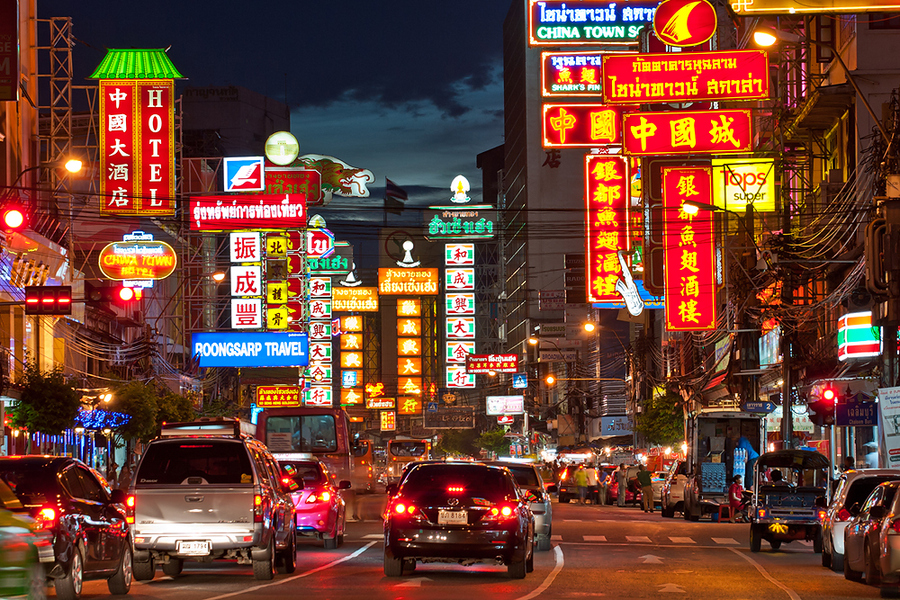
Yaowarat Road at night, lit by shop signs in Chinese and Thai.
Walk through Yaowarat and you will notice bilingual shop signs, gold shops, traditional medicine halls, small shrines and food stalls that stay busy late into the night. Talat Noi, a short walk away beside the river, has older shophouses and quieter lanes. For a closer look at the area itself, read our post on Bangkok’s Chinatown.
Why Do Some Thai Surnames Have a Chinese Root?
In 1913, during the reign of King Rama VI, everyone in Siam was required to take a family surname. Many Chinese families chose a Thai surname, sometimes one that translated or echoed their old Chinese name, while others kept the Chinese name with the prefix แซ่ (sɛ̂ɛ).
The Thailand Foundation gives some neat examples. Families who kept their Chinese name became Sae Tang, Sae Jong or Sae Lim. Others translated it: the family name Bae (马), meaning “horse”, became ศิลปอาชา (Silpa-archa), roughly “artful horse”, using อาชา (aachaa), a Thai word for a horse.
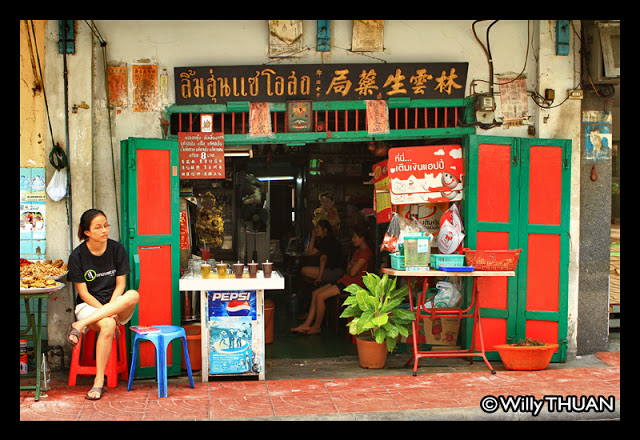
A small Chinese-Thai herbal shop with a bilingual signboard. Photo © Willy Thuan.
That is why a surname on its own tells you very little. Plenty of Thai-Chinese families have ordinary-looking Thai surnames, and a long or unusual surname does not mean a family is Chinese.
Frequently Asked Questions
- How many Thai people are of Chinese descent?
- Where did most Thai-Chinese families originally come from?
- What Thai words come from Chinese?
- Is Chinese New Year a public holiday in Thailand?
- Where can you see Chinese influence in Bangkok?
How many Thai people are of Chinese descent?
There is no official figure. Minority Rights Group, in an overview updated in March 2026, estimates about 9 to 10 million people, or roughly 13 to 15 per cent of the population. Older figures differ because they were counted in different ways, and most Thai-Chinese people simply identify as Thai.
Where did most Thai-Chinese families originally come from?
Slightly more than half trace their roots to the Teochew area of Chaoshan, in eastern Guangdong in southern China. Hakka, Hainanese, Cantonese and Hokkien families also settled in Thailand, and there is a Yunnanese community in the north.
What Thai words come from Chinese?
Many everyday words come from Teochew, including ก๋วยเตี๋ยว (gǔaidtǐao, noodles), เก้าอี้ (gâo-îi, chair), เต้าหู้ (dtâohûu, tofu), ห้าง (hâang, department store) and หุ้น (hûn, share). Food words are the biggest group.
Is Chinese New Year a public holiday in Thailand?
Not nationally. Time and Date lists it as an observance in Thailand, so most businesses keep normal hours, even though it is widely celebrated. In 2027 it falls on Saturday 6 February.
Where can you see Chinese influence in Bangkok?
Yaowarat, Bangkok’s Chinatown, is the most obvious place, along with nearby Talat Noi and Wat Mangkon Kamalawat. You will also see it in noodle stalls, family shrines and markets right across the city.
Learn a Little of the Language Behind the Mix
Once you know a few of these words, Bangkok menus and market chatter start to make more sense. You spot gǔaidtǐao on a sign, hear someone call the stallholder jée, and know where both words came from. If you’d like to learn the Thai behind everyday life here, have a look at our Thai courses at Duke Language School. And if the Chinese side of the story has caught your interest, we now teach Chinese too: see our Chinese courses.
Sources
- Minority Rights Group (updated March 2026). Thailand. Population estimate for people of Chinese descent, and the note that official figures are not available.
- Chris Baker and Pasuk Phongpaichit. A History of Thailand, 3rd ed. (Cambridge University Press). Teochew ancestry and King Taksin.
- Martin Stuart-Fox. A Short History of China and Southeast Asia: Tribute, Trade and Influence (Allen & Unwin, 2003), p. 126. Historical population estimates for 1825, 1910 and 1932.
- Theraphan Luangthongkum. “The Position of Non-Thai Languages in Thailand”, in Lee Hock Guan and Leo Suryadinata, eds., Language, Nation and Development in Southeast Asia (ISEAS, 2007). The 2000 census language figure.
- The Nation (7 Jun 2025). Surprising Chinese origins of common Thai words. Everyday Teochew loanwords.
- Thailand Foundation. Chinese New Year Festival in Yaowarat, Bangkok. Surnames, Yaowarat and Chinese-rooted festivals.
- Time and Date. Chinese New Year’s Day 2027 in Thailand. The 2027 date, listed as an observance rather than a public holiday.